


Back in October 2025 I wrote a piece entitled “Tall Poppies”, highlighting Britain’s culture of cutting ourselves down - arguing that our discomfort with tall poppies, i.e. those who stick their head above the parapet and try to strive for something better, was one of our great national malaises.
It struck a nerve - lots of people nodded their heads in a very British fashion - enough to be part of the chorus, but not enough to actually stand out. Unsurprisingly, it didn’t get us anywhere - I evidently diagnosed something, but this was the easy bit. Trying to do something about it is something entirely different.
In conversation with Josh (of Plugged), I realised this is a topic I feel pretty strongly about, and that most of the things I care about are downstream of ambition and confidence. Given I work in arguably the most dynamic part of the UK economy, I’m luxuriously situated close to people who aren’t limited by these concerns - giving me a front row seat into what could be done to tackle some of these problems head on.
I don’t expect to solve the British discomfort with ambition overnight, but I do believe there are ways to start building the talent pyramid from the bottom up and supporting it as it grows. By normalising ambition, widening the funnel of people willing to take swings, and building the infrastructure to support them as they grow - we might just be able to spit more successes out the top.
[As a caveat up front, this is very London centric. This is a deliberate choice - both for focus, because I know it best, and because whether we like it or not, the city makes up ~22% of the nation’s economic output, and ~60% of the tech sector. The logic herein should be portable to any other location.]
Setting the context
As we pinball through the first months of 2026, this feels ever more relevant. The barriers to entry for founding a business are trending to zero. A smart teenager with Claude Code or Replit can spin up a fully fledged company in less than a day - with everything from product design to hosting to merchant of record built in natively and set up for <£100.
We are also staring down the barrel of an economy that is almost unrecognisable from the one Josh and I grew up in. If the much discussed AI 2027 or the 2028 Intelligence Crisis are anything to go by - we are at the foothills of a sectoral shift not seen since the industrial revolution. Even if they are mostly wrong, the changes are still likely to be profound.

Within this environment, not only will the number of traditional white collar jobs decline sharply, but on the flip-side, the autonomous entrepreneur (see: builder) may well be king - limited only by speed, hard work and scope of ambition/imagination.

We have a chance to drive our ageing, services-led economy forward, but we’re also in dire need of a wake up call. So what can be done to build a nation of entrepreneurs?
Reframing ambition
Not unreasonably, the “aspirational” route for many top grads in the UK has long been Partner level at a major consultancy, law firm or financial institution. This job has traditionally been stable, highly well paid, relatively high status. We are a nation of service-people - pinstripe suited, subtle in our manner, with quick wits and sharp tongues ready for whatever CEO, politician or private client needs our input.
Josh calls this the “consulting industrial complex” - legions of service providers who add a sum total of not that much to the wider economy. They do not create, they facilitate. Scrum Masters, deck builders, proposal jockeys.

These are the darlings of the careers fair. Josh and I were both very lucky to go to a top university - and not only were we not taught a single thing about the world of work in our time there, but both our careers fairs, four years apart, were chock full of this kind of opportunity. Accordingly, our most brilliant friends went into IB, consulting or law. There was nothing from small tech or even big tech. Venture didn’t feature. Being an entrepreneur? Not even on the menu.

This feels indicative. Those in the working world wildly overestimate the literacy of graduates regarding the wider job market. The frame of ambition students are presented with in their final year often becomes the reference point for where they land.
Now - it is a very important point to note the privilege baked into risk taking. Having no safety net is the luxury of those who have one provided for them. There will always be those who are financially safe enough to try, and those mad enough not to care. These trailblazers have built our unicorns to date. But they’re not enough, and more importantly, they’re not representative.
We need to create, and normalise the pathways for those traditionally excluded from this route by either lack of awareness or lack of security. The young people with the highest stake in changing the world - the ones for whom the current system is most broken - are precisely the ones for whom the risk is most existential. We’ve built a system that selects for people who can afford to fail, but this isn’t a talent engine that functions for a wider society.
Yet what I suggest is that with the right structures, the perceived risk and the real risk can be more different than they might immediately appear. The first few years out of school or university provide a perfect time to test this difference. If the downside risk can be demonstrated and capped, through fellowships, spaces, anti-grad schemes, programmes and the like, the unlimited upside can be revealed.
The work we have to do here is provide the stories and the access to new ways of thinking. Encourage shackles-off ambition. Capture young people before they become institutionalised, salary trapped, mortgage bound. We need coordinated infrastructure that catches people early, supports them through the messy middle, and tells their stories back to the next generation.
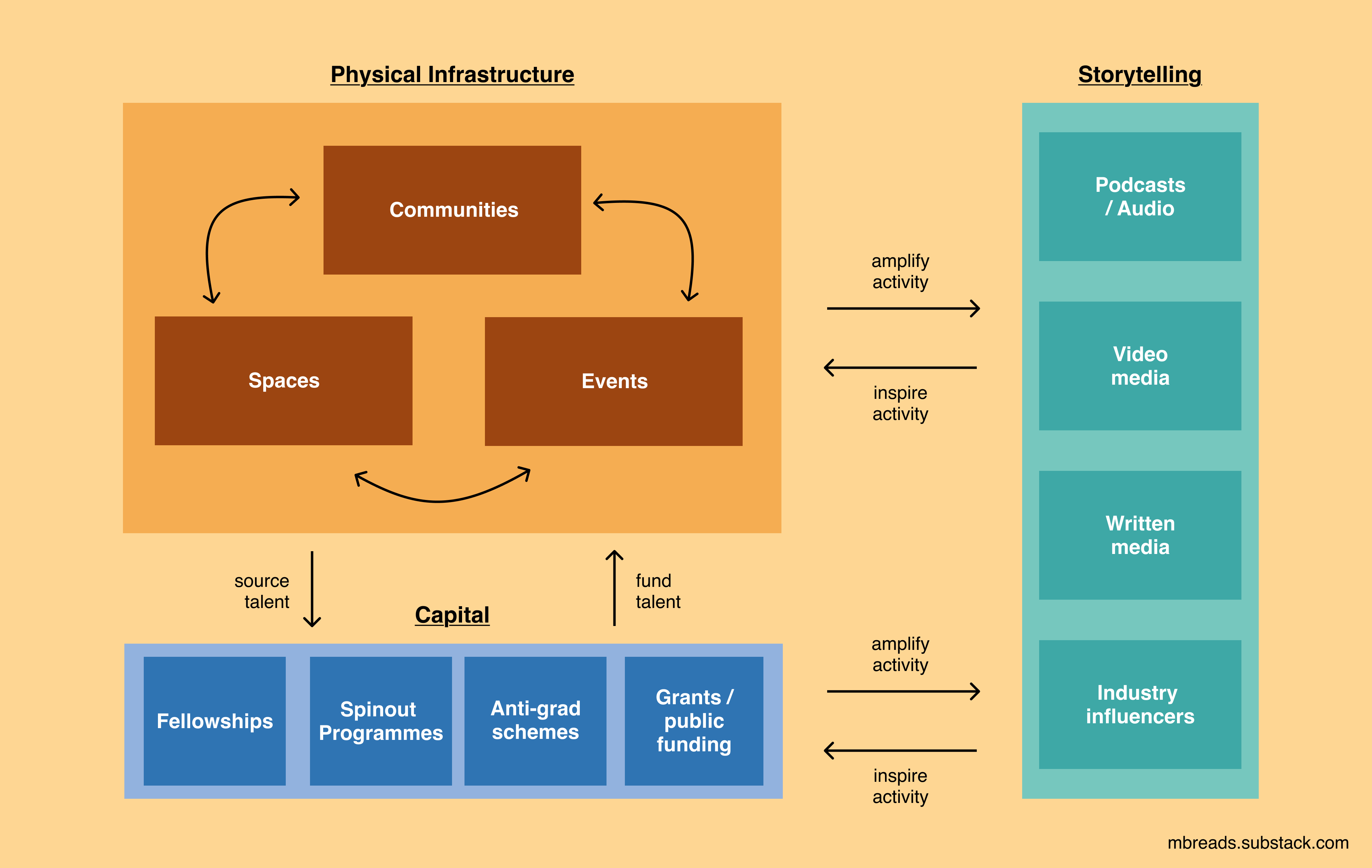
That infrastructure has three layers - spanning (1) Storytelling, to educate and amplify, (2) Physical Infrastructure to support, connect and multiply and (3) Capital, to both limit the downside and supercharge the upside.
1. Storytelling - a new media landscape
The first pillar in this new landscape is telling the stories that inspire. We are currently in an environment where entrepreneur-focused news fails to break through into the mainstream, and so the majority of the people we want to build don’t even know it’s an option.
Traditional media just doesn’t tell these stories - for the reasons laid out in Tall Poppies multiplied by a national obsession with celebrity and scandal, ideally as salacious as possible. Furiously ambitious people doing extraordinary things just don’t sell within this system.
Tall poppies

Britain is exceptional at inventing things, but not very good at turning them into businesses. I think this is as much a cultural problem as it is an economic one.
The example I often refer to is “name me a famous UK entrepreneur” - you either get Dyson or Branson, two septuagenarians, or Steven Bartlett, an influencer with a podcast. Where is the national storytelling around Greg of Octopus, Tom from Monzo, Mati of Elevenlabs, Victor of Synthesia, Nik of Revolut, Walter of Fractile, Poppy of Darktrace and the like?
These stories aren’t breaking through - and if our ever-mercurial and rapacious national media won’t cover them, we need to shortcut this by building and amplifying new channels to boost the system as a whole, pulling people into the sector and then in turn amplifying the stories that come out of it.
While the sector itself is doing a good job at starting some of this storytelling, this is currently limited to an already-informed audience. TBPN wrote the social media friendly news channel narrative in California (to incredible success) and etn has followed (perhaps a little too closely) in the UK. We’ve got Ventures focused on short sharp interviews, and Plugged with a social-first approach.

Harry Stebbings has done a phenomenal job with 20VC, but he’s a one man outlier currently, and still tends towards an industry-insider approach. Tara Keeney’s TikTok friendly work walking with founders is impressive (and could be a crossover success), new entrant UK2.0 is telling many of these stories, and Simon Squibb is perhaps the most approachable form of normalising entrepreneurship. But this is nowhere near enough.

These stories are mostly within an echo chamber. Linkedin live streams spinning in a bubble of already-informed parties. Where’s the Tiktok native version? Who’s owning this for the YouTube shorts audience? Where’s The Generalist’s UK-native version, romanticising entrepreneurship and going deep on the outlier stories that inspire?
Who’s our Tim Ferris (taking the interpersonal side of entrepreneurs’ stories mainstream), Packy McCormick (making business strategy actually entertaining) or Anu Atluru (bringing beautiful writing to tech sector analysis)? Substack has democratised blogging - the limiting factor is energy not reach. X is a cesspit, but one that can be worked by the right hands. Less than 10% of podcasts make it past 10 episodes. A thousand more accounts or podcasts is not just noise, it’s momentum - media is not a zero sum game, and competition is no bad thing here. We need to move from “that’s not how we do things here” to “this is the story we need to tell”.

2. The physical infrastructure
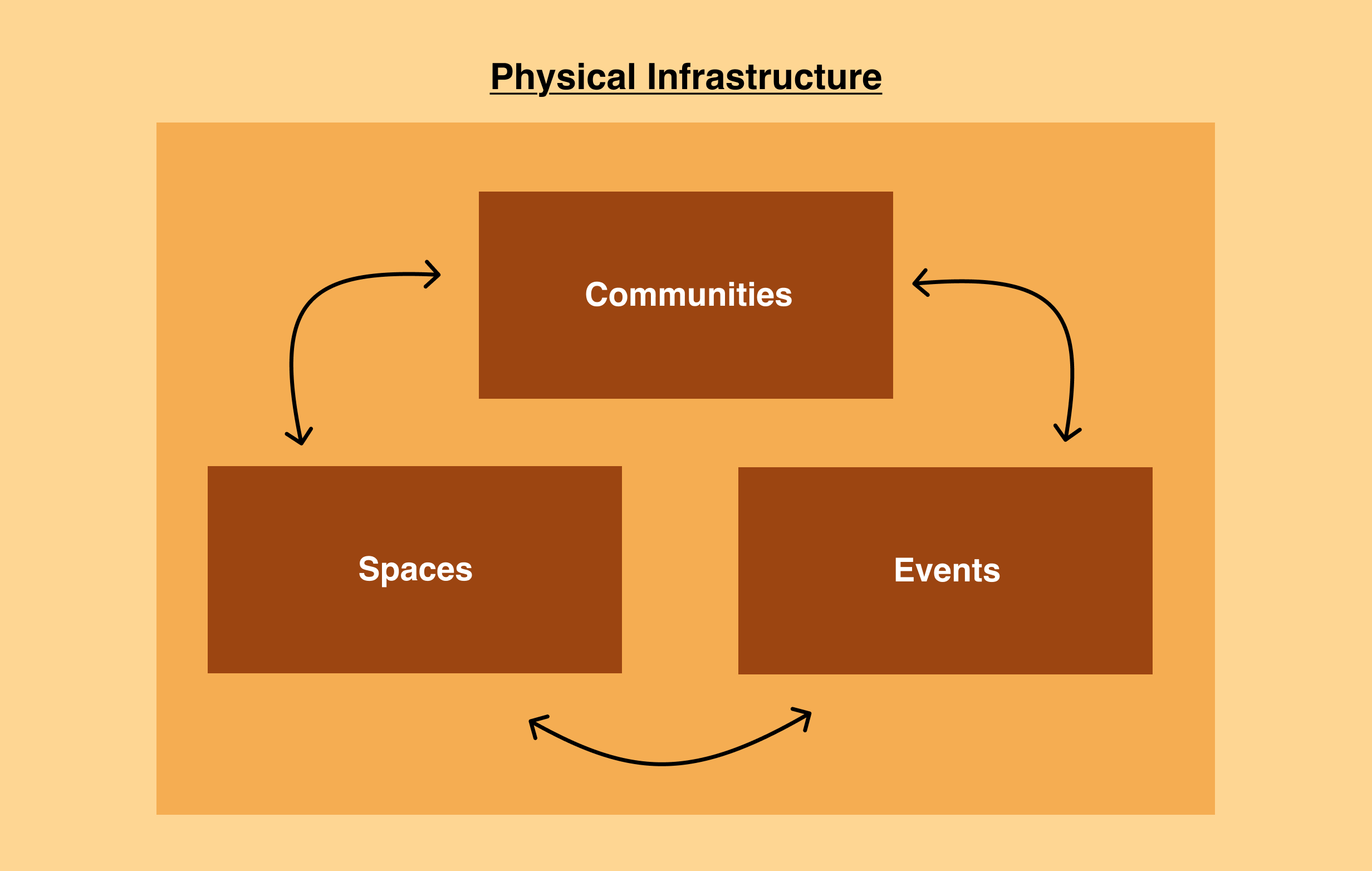
To amplify stories, they need to be written - and this starts by getting people in the same room. This physical infrastructure comprises three interlinked parts - events, communities and spaces. An event introduces someone to a community. The community gives them a reason to show up at a space. The space produces work that becomes the content for the next event, and so on.
Events are in many ways the backbone of the entry-level ecosystem. The easiest gateway point for a young person into a new sector is often a meet-up, hackathon or fireside chat. Alexandria Lab in SF/Munich and In Silico, SoTA, or txp in London have demonstrated how talks don’t have to sacrifice on quality to reach wider audiences, while Plugged and London Founder House have gone more “bottom up” in their open-to-all house party approach.
Hackathons are equally valuable, as long as they’re quality, and the work of communities like SoTa alongside vibe coding scale-ups Lovable, Openclaw or Cursor are making everyone-can-build-software a reality for a broader audience.
What’s valuable is diversity - providing as many entry points to the novice as possible, and bridging the literacy gap between newbies and industry insiders. Broad, horizontal meet-ups, deep-dive vertical communities, small discussion groups are all part of the equation. The health of the ecosystem in many ways can be viewed as a function of the number and quality of this kind of event.
These events feed and are fed by wider communities, often of the same name - turning individual interactions into deeper connections. Unicorn Mafia, YSYS, Foundervine, Colorintech, Entrepreneurs Collective and the like are vital drivers of the ecosystem, hosting dinner series, longer-form hackathons, book clubs, pitch events, all of which pull the curious in and then channel them into other avenues - a self-reinforcing loop that feeds into, and draws energy from, shared spaces.

One of the most exciting things to come out of SF in the past decade is the founder/hacker house or residential incubator. South Park Commons and The Residency have built incredible talent machines that accept outlier individuals from across the world. FR8 is rapidly becoming the European gold standard, with Pluto House, London Founder House, Telos House, Alexandria House, and more popping up across the UK and continent.

These spaces are exceptional as they not only increase surface area for connection, but show young people what great looks like in a compressed timeframe. Perhaps this is more directed towards the maverick entrepreneurs willing to up sticks and move in with relative strangers, but the model stands - a shared safe space to explore, experiment and then execute.
The challenge with these, and with spaces in general is the business model. Property is a gritty business, especially when your tenants are a gaggle of twenty somethings with little more than laptops to their names. Many of the brand name US houses or spaces are billionaire funded. Much like their university donations, the culture is one of giving back - something we still lack in Britain. The Nordics are shaming us here - Sweden and Finland are seeing an explosion of funded spaces, often backed either fully or in part by successful regional entrepreneurs. This combination of duty, community and national pride is powerful. We need British entrepreneurs to stand up and be counted here - giving both their money and their time to these initiatives.
There is also work the state, property developers and universities can do here - brownfield sites, disused warehouse space, old schools, interim out of use offices all make for excellent work hubs. The barrier to entry should be a locking door and functioning wifi. Camden Council have done some great work here, Imperial College has hackspace but more is needed - and the more centrally in London the better.

It’s exciting that Frontier Tower is coming to the capital - a multi-disciplinary deep-tech co-working and hotel that could well become a real centre of gravity for London builders. This adds to the foundational effort of Entrepreneur First in building a hub around Shoreditch Exchange. But we’re still lacking a Station F-style nucleus for big and small tech to meet in one place.
This connection within spaces is the key unlock - having the space is one thing, filling it with mentors, role models, potential customers, teachers or funders is another. Bigger companies could do a lot with excess desk capacity, or funds, like Localglobe with Phoenix Court to foster this connection.

This is a multi-faceted chimera of a challenge, in no way solvable by a single actor. It requires collaboration between dozens of bottom up events and communities, and the more centralised driver of funded, collaborative spaces. The last piece of this puzzle is arguably the most obvious, but still worth examining - the capital stack to fund the ecosystem and drive both the talent and media machine.
3. The capital stack
Capital is the fuel that drives this people machine, and is key to de-risking an entrepreneurial route for those not fortunate or insane enough to dive in with no armbands. The grad scheme may be dull, but it is paid, and for even some of the most ambitious young people, a steady wage in an uncertain world is hard to turn down.
To function effectively, the ecosystem needs a variety of funding routes for young people - covering routes into jobs in entrepreneurial firms, fellowship funding for exploration periods, non-dilutive grants for foundational research, company foundation support etc.
Starting at the earliest touchpoint, programmes like Relativity Collective or Zero foster this awareness and connection before individuals leave institutional education - offering short courses, summer camps and community for founder-curious profiles before they’re free agents.
For those still in academia, Wilbe and Creator Fund provide funding for academics who are either unaware of how to spin out or scared of making the leap with no backing. There is much to learn from Canada here, who have built multiple competitive (semi-public) routes for AI researchers looking to leave academia via Mila and the Vector Institute - providing a third path for academics away from staying in education or taking a job in a hyper-scaler AI lab. There is neither the time nor the appetite here to take on university tech transfer offices, only to say that every day our top institutions lack standardised terms for funding, equity and IP transfer is another day wasted.

For hungry generalists, Entrepreneurs First is a brilliant route - and is an unusual example of a genuinely globally competitive accelerator programme. While for those not ready to get straight into building for themselves, the “anti grad scheme” products of Jumpstart, {Tech: Europe} or Null Fellows bridge the information gap between young people and exceptional opportunities.
Adjacent to these more structured programmes or job searches are fellowships - giving precocious or deeply curious young people the funding and freedom to explore their ideas without short term salary pressure. While furiously competitive, the Thiel Fellowship has paved the way for funded fellowships for the most unusual of young entrepreneurs, alongside Spec.tech and Kevin Hartz’ personal work in the US. We need more of these - Project Europe is having a good crack (in spite of the depressing gender breakdown of the backers), EWOR is hoovering up excellent European talent, and Regen are doing interesting work with their worldwide fellowship for “aliens”.

A nod here to ARIA - a truly ambitious publicly funded R&D agency, backing anyone from a solo scientist to founder to non-profit for the specific work they’re doing within their field. This takes the best from DARPA and leans into British strengths, with the unique innovation being the flexibility of funding methods and mechanisms - focusing more on desired outcomes than quibbling over terms.

Following the example of Regen, funds can do more here - it shouldn’t be dependent on behemoth a16z and Speedrun Alpha to fund brilliant people at the earliest stages. Again - this needs our trailblazers to put themselves out there - both in terms of capital allocators giving no-questions-asked small grants to brilliant individuals, and exited founders with money to spare taking it upon themselves to fund the next generation. These fellowships don’t materialise out of thin air, and the likes of InnovateUK do more to fund grant-repreneurship than real ambition. Excepting unusual cases, public bodies just aren’t very good at this type of capital. The private sector needs to fill in the gaps, being patient that the ROI will come, even if it takes longer than impatient investors might hope.

Lastly, equity funding is always worth mentioning. The EIS/SEIS schemes in the UK have built an impressive early-stage funding ecosystem, and the UK is head and shoulders above the rest of Europe in terms of number and size of funds - but more is still more in this case. We need more public angel syndicates like Ventures Together, and individual business angels unafraid to shout about their allocations and interests - as these types of capital can come in before founders or ideas are ready for the beady, hyper-critical eyes of institutional venture capital.
I would argue the UK is well furnished with VC funds at the early stages, and the challenges lie in risk-on angels for first cheque funding, along with later in the fundraising journey as founders need deep institutional capital to plug the UK -> US leak as teams raise from US funds in later stages, often more out of necessity than desire.
The view from 10,000 ft
It isn’t often that we get the chance to zoom out on an ecosystem and examine it from afar - as a machine designed to achieve an aim, in this case promoting a nation of furiously ambitious British builders.
While it is challenging to hold something of this magnitude in hand, the exercise of stepping back and asking what best in class could and should look like, and where we could be directing our ambitions is one I believe to be valuable - for inspiring activity, sparking debate, driving connection and sharing stories.
I am a firm and passionate believer in the strengths contained within the British economy, of London as a uniquely global, competitive and welcoming city (even in spite of its endless winters), and the power technology has to both improve our world but also build a more resilient economy. There is a wave of uncertainty coming, and regardless of how great this may be or how long it lasts, fostering an economy capable of weathering this time of change is something we should all be discussing.
By building a media apparatus actively incentivised to tell stories of our most brilliant people and companies, that is fed by a talent machine comprised of events, communities and spaces, and funded by flexible, open-minded capital, we set ourselves up well for increasing both the resilience of, and surface area for opportunity within the economy.
Yet this requires exited founders to write cheques and give time. It demands funds willing to back people before they’re ready. It needs our institutions to move on from obsessing over terms and lean into the upside, not potential downside. It requires young people to show up before they feel qualified. And it calls on all of us to stop apologising for ambition - because otherwise we’re no more than tall poppies cut down once again in the summer breeze.
I’m Max - I write sporadically about things that interest me, often centred around technology and how it affects our lives, while investing in start-ups via Kindred Capital and Anti Ordinary. Loved it, hated it? Neither? Tell me, or just binge my content @ maxbray.xyz
As a ex-lawyer turned tech entrepreneur this hit hard. Think about this every day for Ireland across the water but everything still applies
I love this manifesto Max. Having moved to the US to build, I really do think the psychology of ambition, and openness about that ambition, is one of the key differentiators which the UK lacks.