

2025 was my first year at Davos. I went in with very few expectations, and I went as a novice. I didn’t know the hacks to get into certain extra-exclusive piano bars or mountain top drinks receptions, and I certainly didn't consider this to be “my world”.
But having spent a week in the (increasingly patchy) snow, the whole thing was too fascinating and bizarre not to write about. The following is my attempt to make sense of it all. Hope you enjoy it.
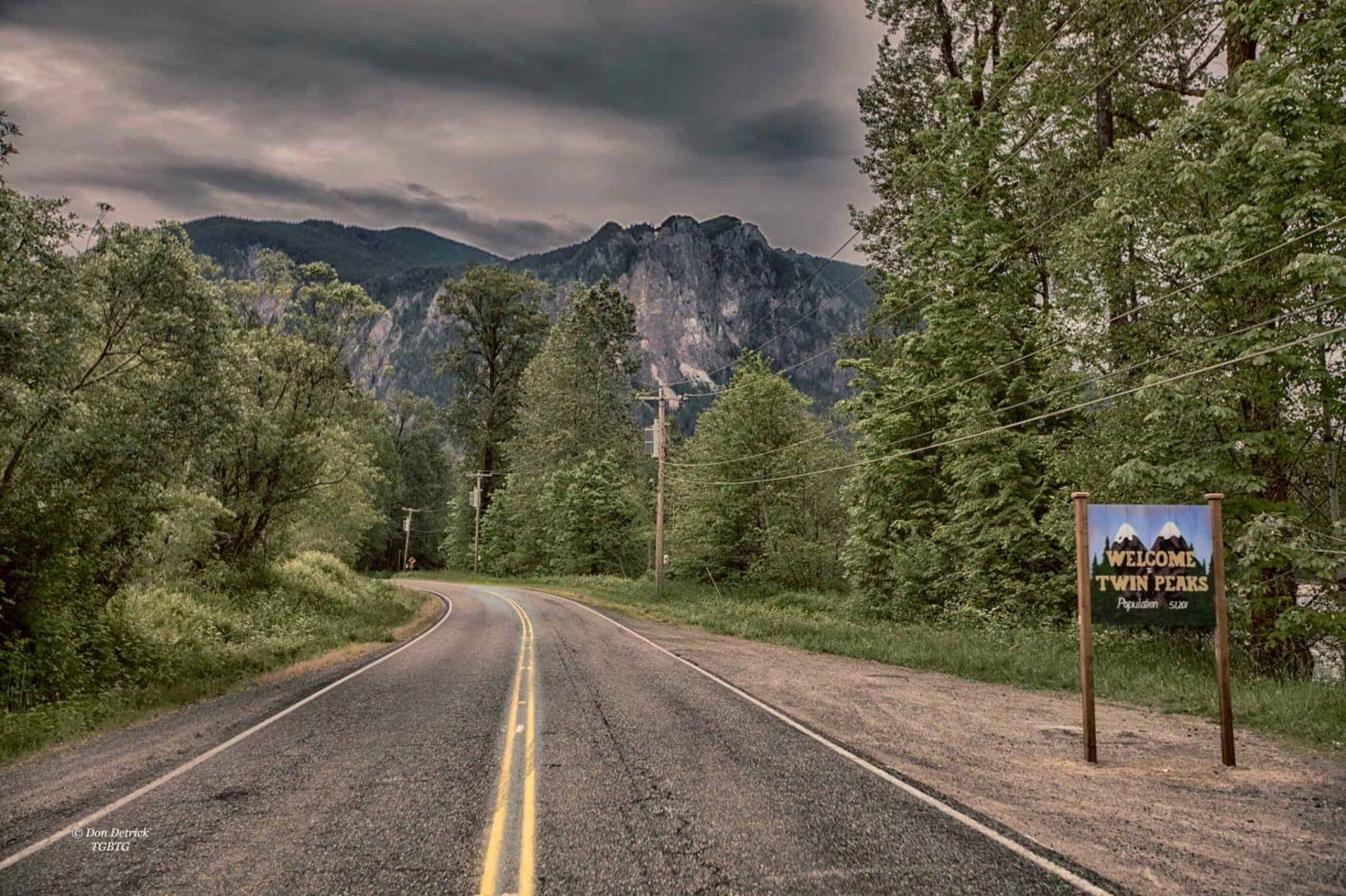
Welcome to Twin Peaks
The first thing to say is that the aura surrounding the place is even stranger than the place itself. I heard it described separately as “freshers week for grownups”, a “corporate popularity contest”, and “hell”.
As far as I can tell, all of these are true, in parts. My initial sensation was one of disdain - at the opulence, illogic, and exclusivity. But, weirdly, there was also something almost charming, bordering on inspiring, about the week.
Amongst all the corporate-washing, posturing and ostentatious wealth, there is a sense of progress and energy. Things are happening, and people want to be here. You have environmental campaigners next to the big tech c-suite. Harvard professors take on TikTok execs on panels. Yo-Yo Ma does an impromptu recital half way up a mountain. And the vast majority of conversations are positive and engaging, with unexpected value around every corner.
However, not only does all of this feel like a lot of talking for its own sake, it is also impossible to avoid the sense of the world moving on. Attendance was notably down on previous years. The big hitters felt fewer and further between. Nationalism is trumping globalism, and governments appear split between internal gridlock and external bellicosity.
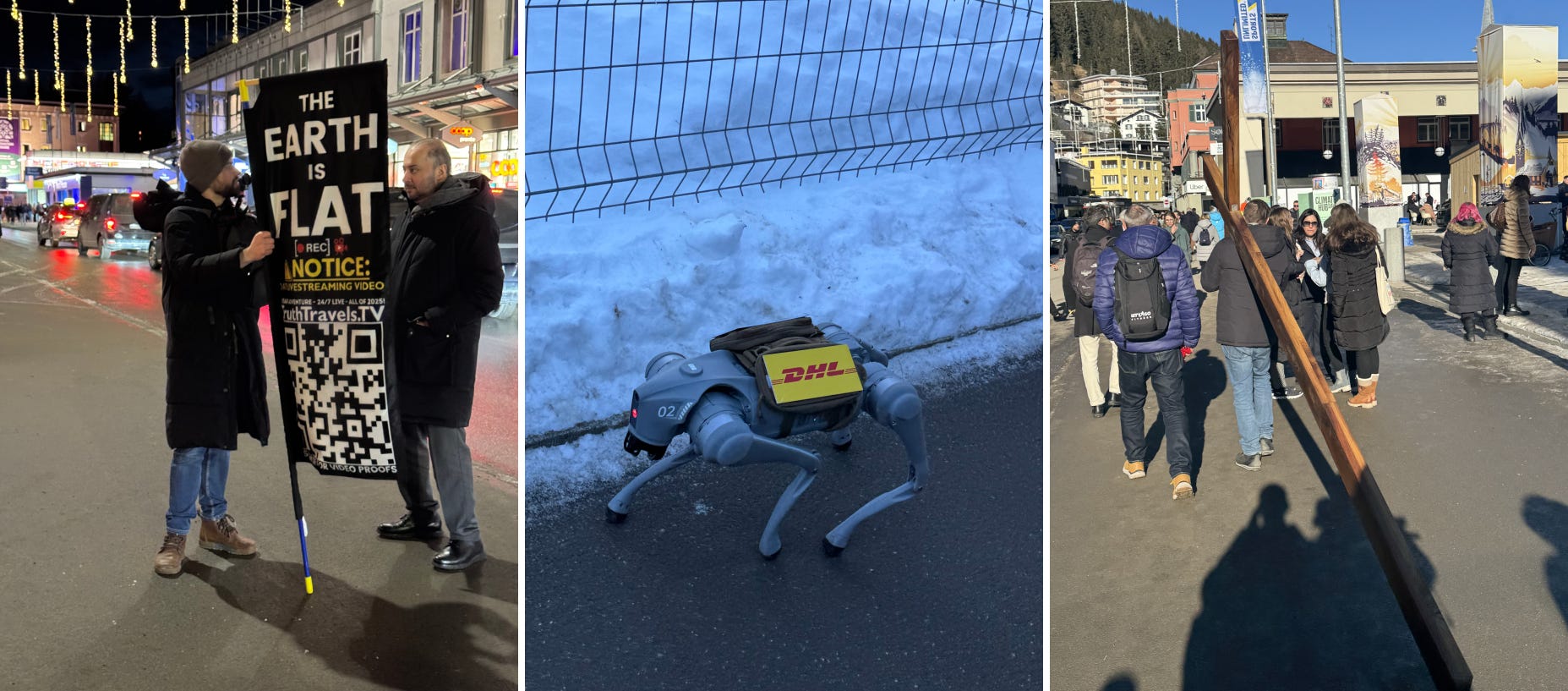
So has the macro moved on?
This was the question I found myself asking all week - and one way to view it was physical. Looking at the houses on the promenade, there were three main categories:
Big powers (e.g. US, India, Google, Meta, Salesforce)
Wannabe big powers (e.g. Brazil, Poland, Indonesia, Qatar, Saudi)
[Those who service the powers (e.g. Deloitte, McKinsey, BCG, Bain etc.)]
The service providers remain constant and predictable, but the other two categories were fascinating. The newer entrants wanted to flex their growing strength - India, Qatar and Saudi had multiple, muscular structures, vying for their place in the new world order, while smaller nations pitched hilariously inviting tax regimes to draw in international dollars.
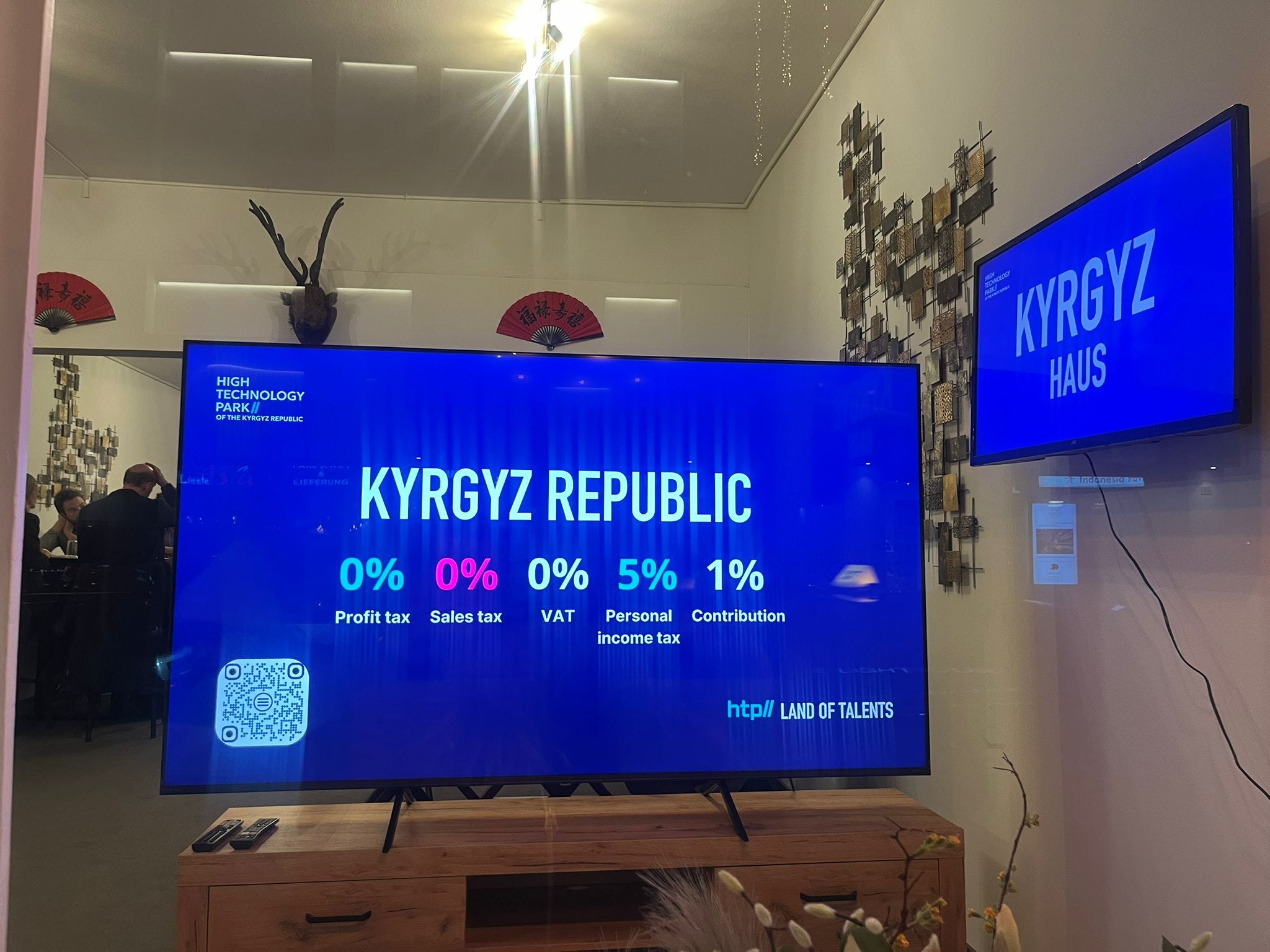
While amongst the G8 - only Japan and the US were present physically, and both pretty conservatively. Even the US were relatively muted - a small townhouse featuring only one obnoxiously large eagle emblazoned on a window. The absence of China or Russia felt notable. And there were no major European powers present (save Poland) in any formal capacity, giving off a sense of the US looking elsewhere, and the old world lacking either the interest or energy to even play the game.
Now maybe this isn’t that surprising. Trump was inaugurated on day 1 of the week, and all the big guys were at his party. He is both a cause and a symptom of this macro trend - the concept of a global gathering feels impotent and anachronistic in an age of protectionism, tariffs and war. European nations remain so myopically focused on their own problems that their focuses appear elsewhere - the best the UK could manage was the chancellor joining to pitch businesses to please be taken seriously.
As one panellist noted, “we’re in the era of individualism and everyone is out for themselves”. Ukraine’s presence felt like a cry into the abyss, and the “here we go again” feeling to Zelensky’s speech emblematic of the broader struggle - exhausted as we enter the third year of the war.
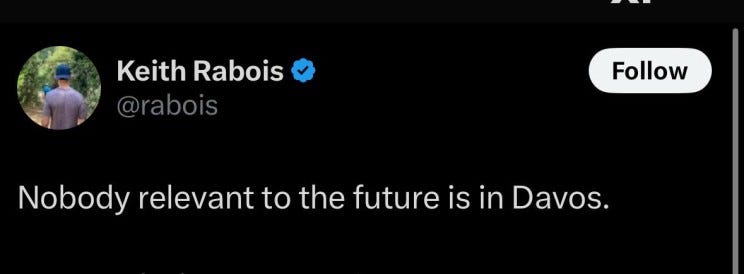
But this begs major questions for the +50 year old alpine gathering. If the shine is coming off it (as noted by Semafor, the Spectator, the FT, seen through Olaf Schulz’s half empty speech or Keith Rabois’ tweet), where does it go?
What replaces it? What would we lose for its absence? Or would anyone even miss it?
The 1% don’t help themselves
Switzerland. Mid Winter. Mountain Resort. Thousands of people. Deadlocked traffic. Talking shop.
The whole format of the gathering feels outdated and does zero favours to a global elite already under fire across the globe for serving themselves ahead of the average citizen.
The structure made sense in 1971, with “450 executives from Western European firms”, seeking an escape from the day to day - before social media, 24h news cycles and always-on politics and business.
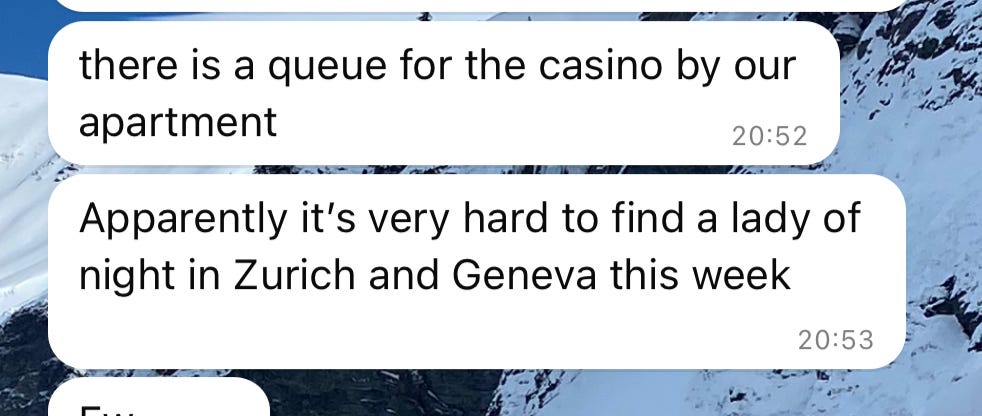
But now we’re at +3000 annual attendees, before you factor in drivers, assistants, family members, security and Switzerland's finest escorts. The location of an event like this makes little difference, and everything is broadcast to within an inch of its life almost exactly as it happens.
There are so many questions. Why is it in one of the most expensive countries in Europe, during the least hospitable time of the year, in a remote town that can barely handle the infrastructure requirements, for a whole week?
Thankfully, one of the unexpected amusements of the whole get together however is that it has the power to make quite literally everyone feel inadequate as there’s always a cooler, more exclusive party. Drinks with David Beckham? Invite only. Round table with the UK Chancellor? Not even publicised. You didn't make it into Goals House? Such a shame.
You’re the 1%, until you’re there. You find that there’s always someone a bit higher up the invisible ladder. I’d be lying if this feeling didn’t infect me at various points. And this tension is what defines the place - on one hand you are constantly confronted with the maddening illogic, but on the other you brush shoulders with some of the most inspiring and impressive people on the planet.
AI for everything, but not the useful kind
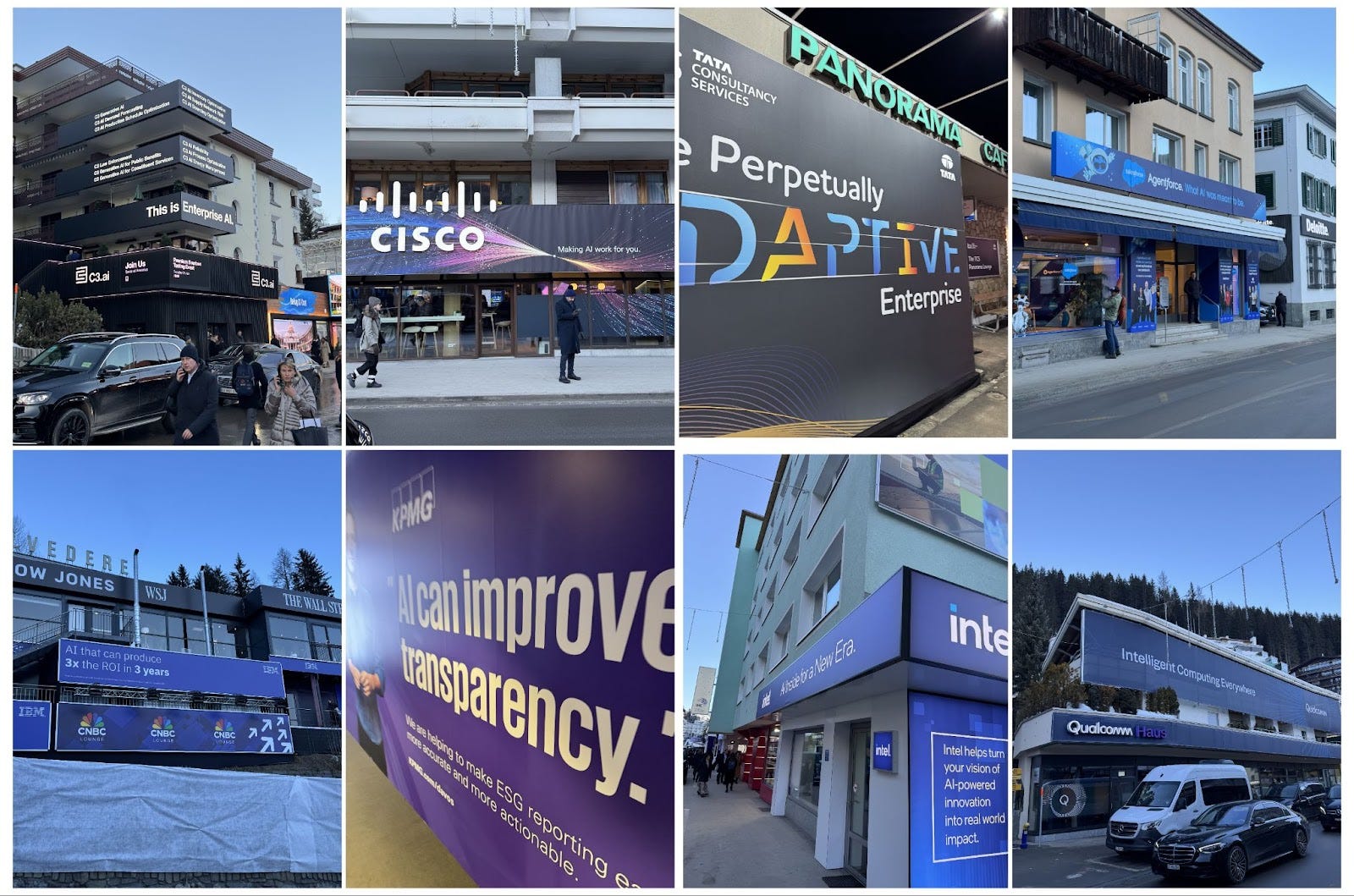
According to the Davos promenade, AI is here to stay. Every major corporation’s frontage was emblazoned with the two letters that defined 2024 and are already defining this year.
Qualcomm, KPMG, Intel, Cisco, Cognizant, Deloitte etc have all “pivoted to AI”, and were using their buildings to pedal their wares.
This isn’t a problem in and of itself, except for the fact that it felt off the pace. While “Big Four €1m AI-Copilot For Customer Service ©” might be a useful way to persuade the board to get rid of a few hundred of those pesky humans you still have to pay, there was so little substance to it all that it almost felt like a parody.
This really wasn't helped by the fact that - having spoken to regular attendees - the space taken by “AI” was previously “crypto/web3” in the late 2010s, then briefly “metaverse”, before a foray into “ESG/climate”. It’s good to see the big guys have a good hit rate on their sector predictions.
I left none the wiser
Yet despite all of this, I return with a gloriously diverse stack of business cards and a feeling of renewed energy about what we’re building.
Yes, the sense was that the world is re-polarising, and that these two poles lie to either side of Europe - in the emergent developing nations of the middle and far east, and back in the hands of an emboldened US.
And yes, there was far too little panic about the state of the climate, nor practical action on the troubling state of Western Europe.
But I left Switzerland lacking a viable alternative. Where does one put these minds, these ideas, and these individuals looking for something new, better, or different?
Maybe we’re all sipping champagne and bemoaning regulatory headaches while the kindling is laid below Rome, or maybe that conversation is a vital part of our very human need to share, connect and interrogate our ideas against others.
I’m still not sure which one I believe.