


Next week, Lawrence and I are hosting a roundtable entitled “so we have nuclear fusion, now what?”, examining what stops, starts and changes when nuclear fusion is an actual functioning technology - thinking about this brave new world at year 0, year 10 and year 30 of deployment.
In advance of that, it felt long overdue to put down a few thoughts on the fusion space, from the perspective of a layman with a history degree (🥴), but one who has spent 6 months tearing his hair out over what is simultaneously the most fascinating and frustrating technology of this century so far.
[As an important primer, if you want to understand the tech - dedicate 90 mins of your life to the first half of this excellent podcast. It’s hard to imagine anyone explaining it better than the wonderful Dennis Whyte].
The promise of limitless energy. And by energy I mean AI.
For the uninitiated, the implications of this technology are pretty simple: nuclear fusion should generate (nearly) free, abundant energy.
When you have a reactor that spits out orders of magnitude more energy than it needs to run, you unlock a genuine step-change in human progress, moving from a world where energy is a scarce resource to an abundant commodity.
In an era of large AI models whose development is limited (mostly) by the amount of computing power you can give them (which is in turn limited by how much energy you have to both make chips and power them), this means that energy in = AI out, and if you can scale compute exponentially, you are, in theory, only limited by the scope of imagination and speed of execution, not the limits of your power sources.
The implications are as fantastical as they are terrifying:
Super intelligent models (presuming scaling laws remain constant [caveat 1, 2, 3]),
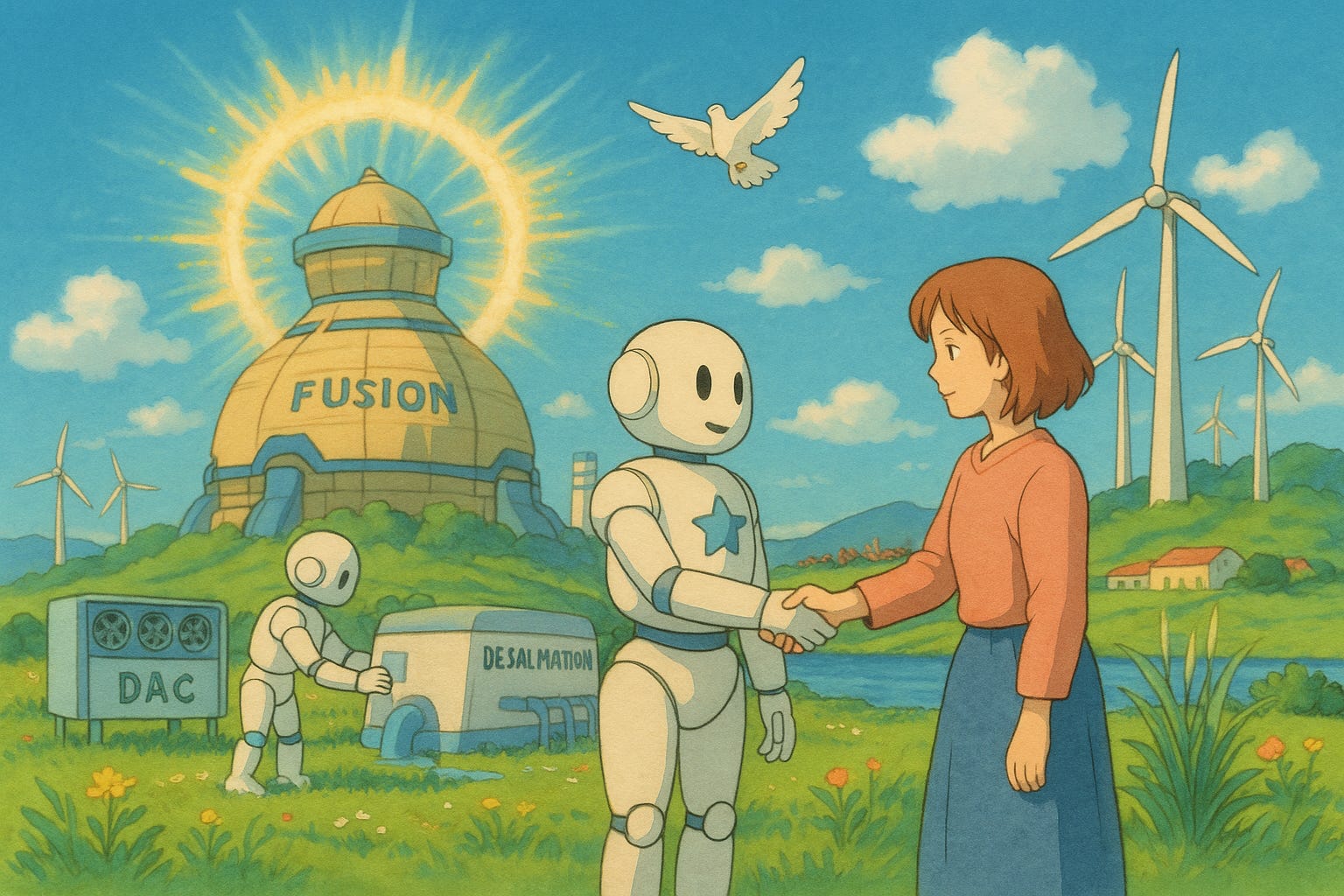
Large scale direct air capture to undo climate change
Cheap cooling for both industry and individuals
Large-scale desalination for unlimited clean water
Colocated power generation for manufacturing, with the constraint becoming time and materials, not energy
Large-scale industrial agriculture meaning fewer limits on food production
Genuine step changes in space travel
etc. etc.
Always 10 years away
But the long standing joke is that fusion is always a decade away, and has been since about 1980 - a suitably nebulous, but fundamental scientific goal (it is, after all, how the universe is powered) that has fascinated scientists since the splitting of the atom, yet has remained chimeric and mercurial since first conception.
However, with market leader Commonwealth Fusion Systems building a reactor to (supposedly) go online in the early 2030s (and recently raising +$850m to do so), China building a monstrous +$1bn fusion plant in Sichuan Province, and investors like Lower Carbon Capital raising whole $250m funds just for fusion companies, there is a strong feeling the market is approaching something approaching viability.
The old adage may still apply (as let’s see what happens with the rubber hits the road of CFS’ new plant x US planning restrictions x engineering constraints), but at least this ten years feels like it might be the last. Or maybe I’ll look back and laugh at myself for being so naive in a decade’s time.
However, this still doesn’t answer some of the more fundamental questions in the space…
Physics vs engineering
As a well-informed Reddit user posted last year:
“One thing that's interesting about fusion is that in principle it absolutely works. We have the core physics all worked out. There's no question about if the mechanism is possible. There's also no obvious concern of “well to make it work, this key parameter would need to have a totally ridiculous value.” So it's hard to ever just let go.
On the other hand, it is an INSANELY difficult engineering challenge. An analogy my [stellarator PhD holding] friend gave was imagining trying to compress water by squeezing a water balloon in your hands. You have to squeeze it really hard and for a long time, but you can't let it suddenly squirt out through some tiny gap in your fingers.
Compressing plasma is nontrivial, and we have to compress it a lot and in a stable, sustainable way. To make things harder, you have to squeeze it without letting anything touch it, because it's stupid hot and radiating. And it can destabilise in a tiny tiny fraction of a second. It's like the mother of all feedback control problems combined with a crazy long list of constraints. The only way nature ever gets it to work is by using a crap ton of gravity that can pull on the plasma from the inside (intrinsically stable), rather than trying to push on it from the outside (intrinsically unstable) -- aka a star.
So I think it's plausible we will actually get it one day. But in my understanding it's primarily a (very complex, very interesting, and very formidable) engineering challenge. Unless, of course, some cool physics breakthrough can come up with a completely novel mechanism that makes it more practically tractable.”
So, while there’s an insane amount of money going into the space, and the physics is, at least in theory, solvable, there are still massive engineering challenges across the three main types of reactors - Tokamaks (plasma donuts contained by magnets), Stellarators (plasma pretzels running along magnets) and inertial confinement reactors (tons of lasers directed at a tiny fuel pellet), including (but not limited to):
Confining plasma - getting very hot, very angry hydrogen to do what you want
Superconducting materials - developing magnets that can be super cooled, super conductive and super strong
Alloys/ceramics that can withstand neutron bombardment - i.e. materials that don’t just fall apart under constant bombardment of high-energy neutrons
Heat exhausts - components strong enough to sit around the super heated plasma without melting
Tritium breeding + handling - creating a self-sustaining (radioactive) fuel source within the reactor
Control systems - sensors + AI to manage this chaotic super heated plasma donut
Extracting the damn energy - turning heat + neutrons into a form of heat we can actually use
Scale / supply chain - building all the crazy parts (gyrotrons, HTS tape, and the materials listed above) at a scale and cost that’s viable for mass use
And all of this is before you even consider a viable levelised cost of energy [LCOE] (“all-in average price” of electricity from a power plant over its whole lifetime) that makes fusion competitive with solar, fission, wind, natural gas etc.
The LCOE is likely a function of time (and learning curves) more than anything, but given how we mismanaged fission in the west, it’s worth taking seriously as a limiting consideration.
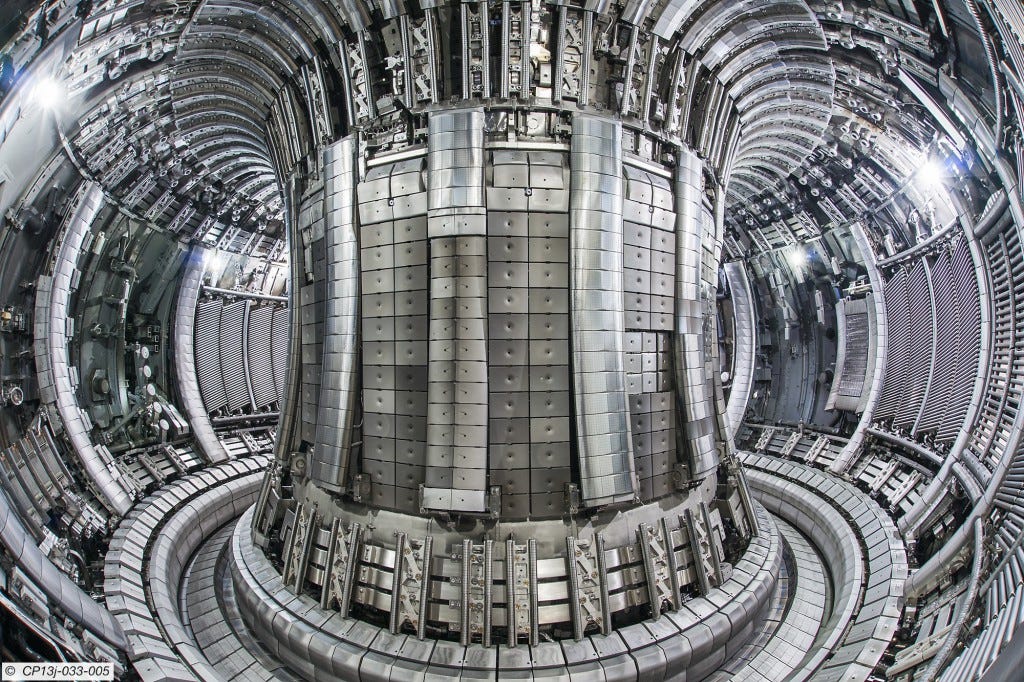
As one fusion founder said a few months back, “nuclear fusion is frontier tech, in about six fields at once: it’s the bleeding edge of plasma physics, chemistry, nuclear engineering, materials science, machine learning and power conversion. No wonder it’s difficult”.
Now I’m rarely one to bet against humans when there’s power supremacy and theoretically unlimited revenues on the line - but understanding the scale of the challenges here can be instructive in grasping why these things have taken so long.
The Manhattan Project for the 21C
And one last area I’ve been thinking about a lot is how this all develops, given the geopolitical implications of this technology.
The Fusion Industry Association (sort of like a guild for fusion co’s, worldwide) noted a record breaking $2.6bn raised in sector in the 12 months to July 2025, bringing the total funding for the 53 fusion companies in the FIA to $9.7bn (5x what it was in 2021). This is an arguably unsustainable amount of companies given the likely winner-takes-most nature of major breakthroughs, and the concentration of capital (e.g. +$800m of that $2.6bn was into CFS alone) in a few very large companies.
When I spoke to a number of the reactor companies in a short period, the elephant in the room was, of course, China. Given their manufacturing excellence, centralised planning, long-term thinking and comfort in over-funding a sector then letting the dead weight die (lots here, here and here), plus the fact the government is literally run by engineers - it feels hard to bet against them.

A number of founders commented that they expect some major QEng > X (i.e. a reactor produces more power than it uses up, including the power needed to run the wider plant) breakthrough from China in the next few years, that will define the course of the next half/decade in the space.
Given the insane promises of limitless energy listed above, this is how I think this could play out:
Major Chinese breakthrough of QEng > X
Furore in Western fusion sector to work out where, how, what exactly etc.
Lobbying of governments to explain that fusion supremacy essentially = economic supremacy, and that lagging behind here would be very bad
[6-12 months waiting for the bureaucrats to wake up to what this actually means]
Panic across the west, and Manhattan Project style consolidation of fusion companies and talent into a few clear regional champions
Large-scale public + private funding of remaining champions with open-sourcing of the key breakthroughs
Long tail is acquired or dies, fusion becomes an established sector
Now this would mean that the 50 companies ends up looking something more like 5-10, with a few European champions across the major reactor types, two or three in the US, and potentially some others collaborative networks (e.g. AUKUS, NATO, EU + UK, US + UK etc.) in the mix.
Which is all well and good - as it will no doubt supercharge the development of this space in the developed world, but what does this mean for all the lovely people who put money into these companies?
What looks like a venture return?
I am, after all, a lizard in human skin venture capital investor, so I have to frame all questions through the lens of “does this make sense to invest in?”. And the short answer is to this question is: I’m not sure.
Despite the fact the returns for winning companies will likely be in the trillions not billions, and this really is one of the most profound technological opportunities humans have ever created, there are a bunch of open questions:
2025 is probably no longer the right time to back a reactor company, given the deep pockets, talent concentration and embedded knowledge of the +50 extant players (although maybe there are lessons to be learned from these over-capitalised first movers).
What do venture returns look like in the event of major consolidation? Is there a fire-sale of the smaller co’s for <$100m, or is it equity driven so everyone ends up with a stake in a few larger players. Neither work well at all with venture fund timelines, unless you own a chunk of one of the few big winners.
Do the consolidated reactor companies become semi-public? Do governments step in here, or does nuclear look like big energy (Exxon, Armco, Chevron etc.) with a handful of global monsters. Or, do the companies even get acquired by big energy (who are perhaps the only global corporations with deep enough pockets, government relationships and infrastructure expertise)?
How do nation states interact with one another? Does each nation need a national champion, or are allies happy to work with just one regional player (e.g. a German champion powering all of Europe)? I can’t see Europe being happy with one nation owning all the upside, so do we end up fragmented and un-competitive? The ITER project feels instructive here.
What are the enabling tech opportunities to make this industry work (e.g. physics-based modelling/simulation companies, gyrotron manufacturers, HTS tape players, tritium breeding companies), and do any of these look like venture-scale outcomes or venture-friendly timelines?
I don’t have the answers to any of these questions (yet), but I find them very interesting - if you do too, or you really hated what I’ve written here, drop me a note and we can argue: max@earth.now.
—
I invest in climate + frontier tech stuff at Earth and Kindred Capital. UK/EU/Israel and a bit of US, pre-seed + seed. Email or Linkedin to get me directly.
There are a lot of really brilliant companies across this space that deserve highlighting, especially those who were nice enough to speak to me. Here are a few: Commonwealth Fusion Systems, Pacific Fusion, Renaissance Fusion, Marvel Fusion, Tokamak Energy, First Light Fusion, Helion Energy, Proxima Fusion, MWB Industries, Zenithon, Kyoto Fusioneering etc.
Thanks for moderating the Ripple at The Drop, it was a fun mental exercise to imagine the world with zero-cost energy. From a venture capital perspective, my POV is that nuclear fusion is not a backable enterprise in 2025. I saw a video by Elon Musk (of all people…) where he talked about the adjacent rooms approach. Colonizing Mars is three doors down, you need to start with the first adjacent business door (better rocket launchers), then the second (Starlink network of LEO satellites) to then make interplanetary colonization a viable and credible endeavor. In the case of nuclear fusion, VCs should bet on the adjacent door of this engineering problem rather than backing the space. I guess the million dollar question is: what are the adjacent doors in the Nuclear Fusion journey?
As another guy with a history degree, this was very enlightening!