

Last week I had the pleasure of seeing Turnstile in concert. The Baltimore-native hardcore group are the current darlings of the performative east-London male, having managed to cross over into appealing to guys who think looking like Matty Matheson is a sufficient substitute for having a personality.
The music is good if unexceptional - high energy bursts of throaty guitars; big, angry drums and lyrics that are memorable yet a tad uninspiring (“Never enough / It’s never enough / Love”). What was undeniably excellent however was the group’s sheer mastery of performance and content, the use of live streaming as an integral part of their show, and the feeling that this was how shared experience works in the era of everyone being Extremely Online.
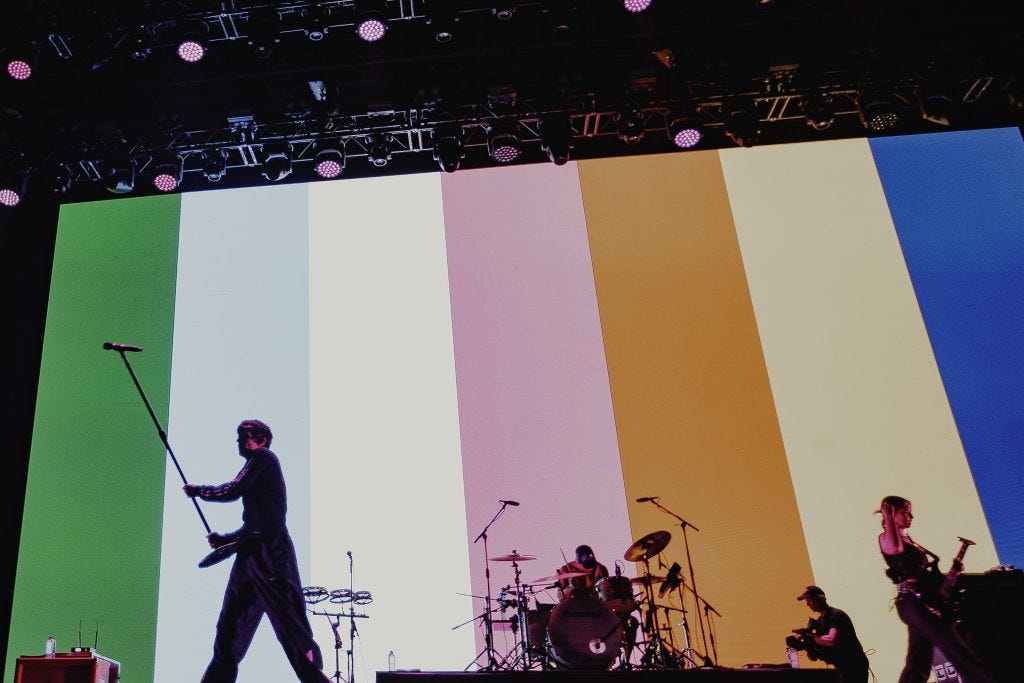
Their set was short and snappy at 1h20 with sub 3 minute tracks and minimal patter (itself something that felt natural for our now goldfish-like attention spans). The band lined up on stage with a massive screen behind the drummer, alternating between tasteful colour palettes that clashed pleasingly with the group’s gritty sound, and streams of the crowd from constantly changing camera angles.
What felt novel and exciting was the two roving cameras moving through the masses, casting live to the big screen. The crowd were literally seeing themselves in real time, but not in classic front row hands in the air style - this was mosh pits from within, crowd-surfing from above, surprised onlookers confronted with the camera’s torch, heads banging and sweaty faces grinning.
There was also a camera behind the drummer, displaying the crowd as seen by the band, as if the big screen was itself a huge mirror. This reflected the writhing masses back on themselves, cutting the intimate close-ups in with collective self observation, like watching yourself take part in a music video - an out of body experience. The production was slick but raw, with a handheld grainy effect reminiscent of 1990s rave videos.
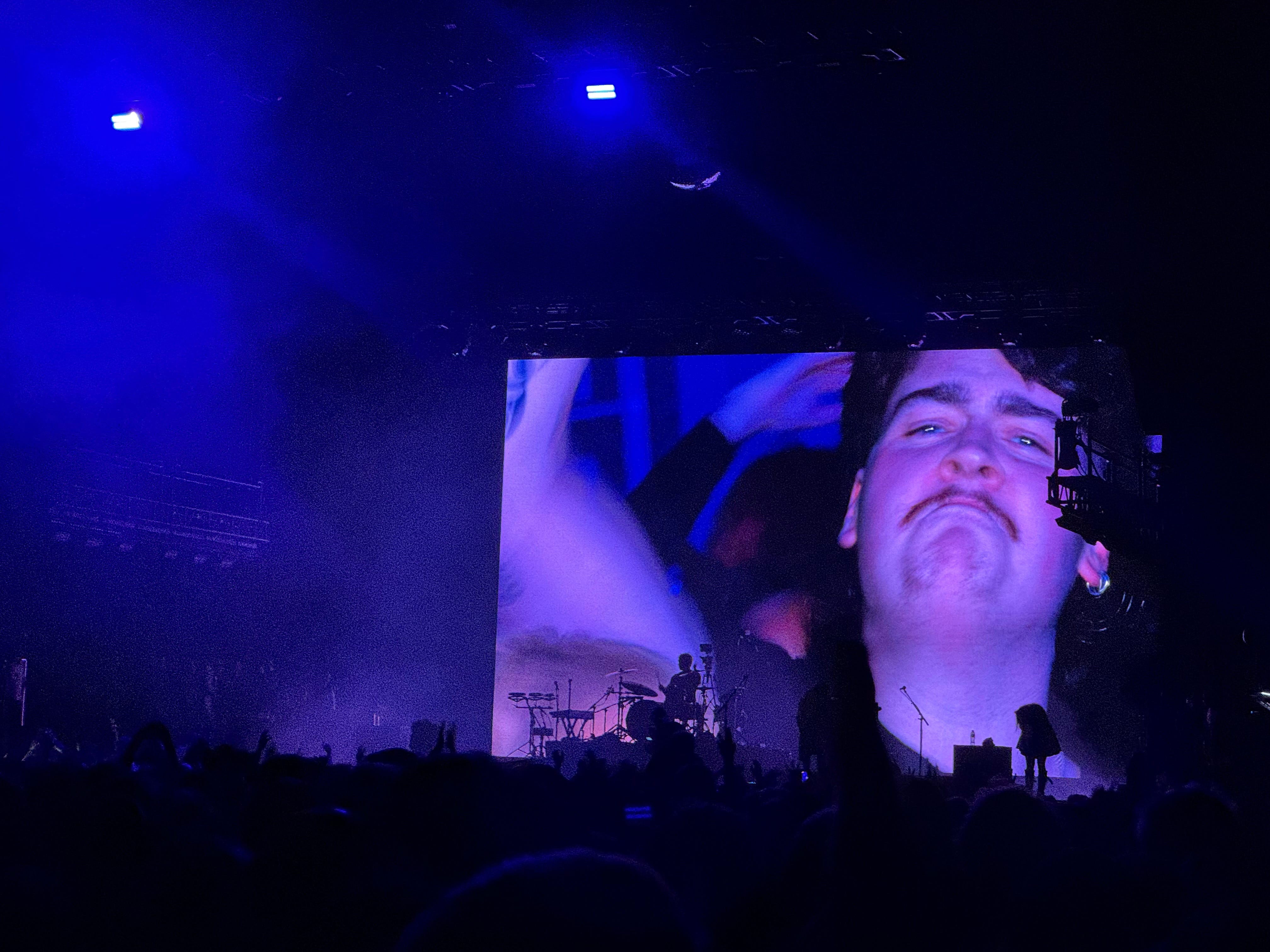
And this got me thinking about how live experience works in 2025. How, to generations that are now almost never offline, and are almost constantly documented by themselves and others, the line between a moment and the recording of that moment has blurred almost entirely.
Traditionally live experience felt like the purest form of content, both more real and more valid, with performance as something didactic - flowing from performer to viewer in one direction.
Yet in an age where everything is captured, shared and immediately pored over, and the viewer can now also be the star of their own content, both real vs digital and performer vs viewer have morphed into something new.
The streaming meant that the whole concert experience felt like it sat in some liminal space between reality and the online world. By seeing oneself on the big screen, or having the constant possibility that you might, the moment felt somewhat surreal - similar to the feeling when you pop up on a friend’s social media post without knowing they had taken a picture of you.
This circular watching me-watching you loop of the live stream big screen dragged the digital into the physical. Not only was something happening, but you were part of it - it was being captured, and so were you, and in that process, it was different - heightened, more textural, or differently textured perhaps.
Within this, I wonder whether the purely analogue experience is now no more real than the hybrid to generations who didn’t know what came before. The concert viewed through the phone screen as the norm - and because everyone is streaming and being streamed at once, the line is blurred between participant and performer.
Positively, this experience felt three dimensional and inclusive - by seeing the fans almost constantly throughout the show (and actually almost nothing of the band), it was as if everyone was afforded main character energy - that the band were merely the facilitator of a shared experience and the individual was as much a part of it as they were.
As my friend Archie noted, “one of the things that the internet was meant to bring was a total democratisation of exchange… no passive audiences gathered around a performance, just the exchange of ideas and entertaining information.” Social media took this and warped it, turning everyone into both performer and viewer at once. The concert felt like a real world manifestation of this idea.
I suppose this is the natural extension of the stadium jumbotron kiss cam, or getting on TV by catching a rogue ball, just in real time and somehow more raw. We have always liked our own reflections, and feel more committed to things we feel a part of - but now we’re in the age of the constant documentary of our own lives - and so like toddlers who know how to look extra cute for their parents’ cameras or influencers live streaming their daily routines, we have come to expect to be filmed - to perform.
I don’t believe these are totally new ideas - all of this boils down to very basic human needs - belonging, participation, vanity and our obsession with the new. The internet has not changed our core functioning here.
It is more that we’ve never had the capacity to blur the lines between self and other to such a degree. We are now able to bring tens of thousands of people into shared experiences like never before - something wonderful and fascinating - that in many ways does feel like it deepens the world we’re experiencing.
Yet simultaneously this constant digital observation of both self and other pulls us away from our real selves, turns us into voyeurs and performers - something innately unnatural to a species not designed for constant reminders of its own reflection. The private has now become the public, and I wonder what might also be lost in the process.
I’m Max - I write sporadically about things that interest me, often centred around technology and how it affects our lives. Loved it, hated it? Neither? Tell me.