

I’ve been thinking for a while about artificial intelligence and job replacement. Not whether I think AI will or won’t cause mass unemployment – frankly right now it’s too soon to tell – but how and where the value gets captured as we shift more and more tasks and economic output from human-led to robot/model-led.
The economics really matter here – when local labour is exchanged for foreign capital, a gaping taxation hole opens up. I’m interested in how a middle-sized nation avoids being squeezed in this environment, especially as the macro is less collaborative, less predictable, and faster moving by the year. Here’s my thinking.
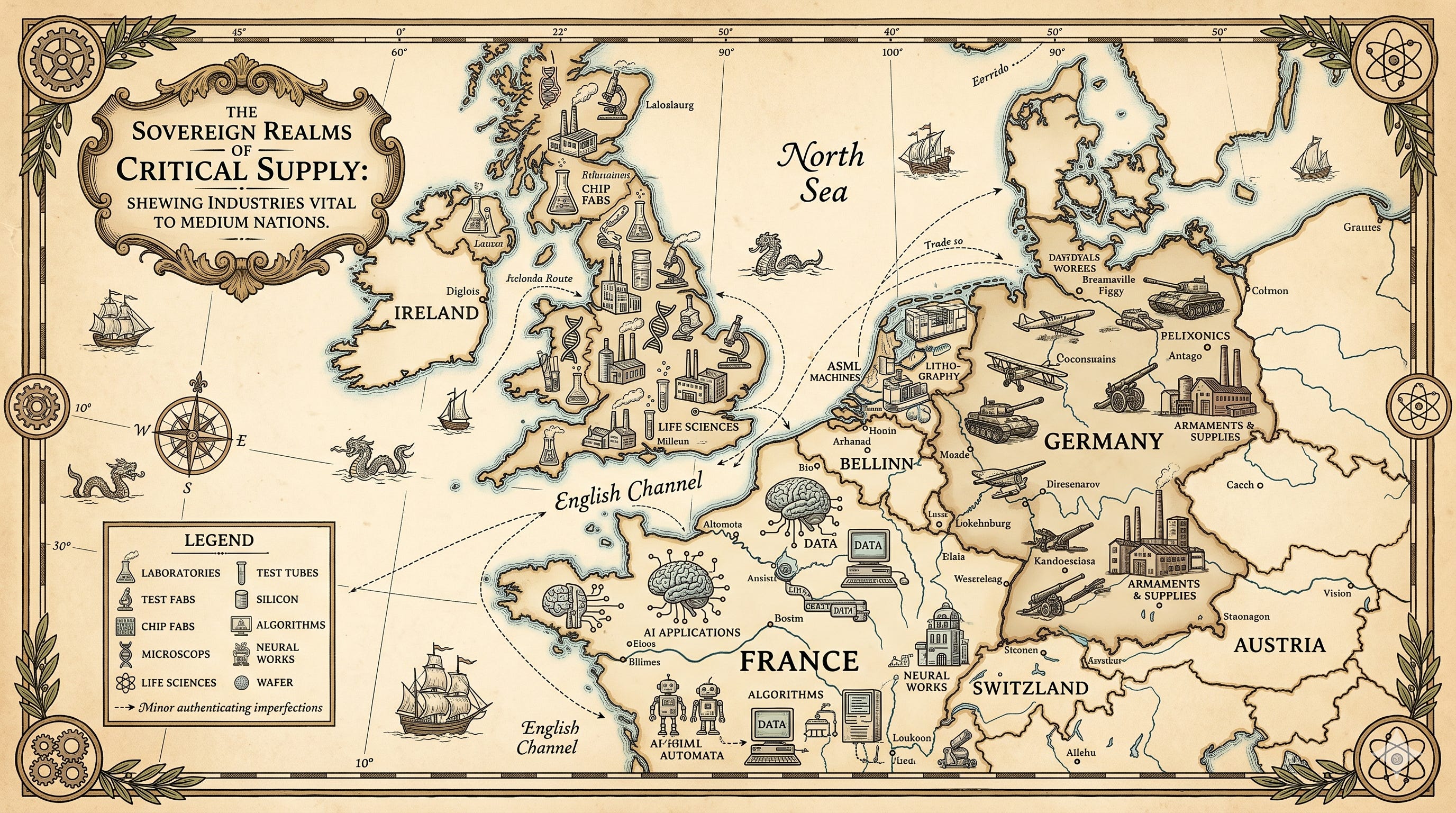
From easy to hard
Anyone working close to technology cannot fail to see the speed with which autonomous systems are improving, across everything from data entry and processing to totally novel scientific discovery.
Alongside this it’s impossible to ignore the speed of development in robotics – not just the models that power them, but the cratering cost of hardware, speed and ease of deployment, and the sophistication of the use cases they now serve.
Across both software and hardware, technology is starting with the easier stuff (discrete controlled environments like data analysis or repeat assembly lines) and moving (at an accelerating pace) towards the more complex stuff (soft touch, humans in the loop, unpredictable environments, qualitative requirements). I wrote about some of these things a few months back in light of declining populations in developed nations:

My worry in this automating environment is not when or whether, but how the world changes. As this recent Economist leader mused, “eventually humans could, like horses in the age of the car, become uneconomical. Income may go mostly or entirely to owners of capital, who then go on to spend it on things that are made by ai and robots using natural resources that they monopolise.”

Let’s play this out in a scenario: labour automation in a British airport.
Over the course of a few years, a relevant percentage of the 75k baggage handlers, check in clerks, shop assistants, waiters, security staff, back office administrators, cleaners etc. at London’s Heathrow airport are replaced by robots and autonomous systems of various kinds.
Heathrow and its tenants buy these products and services from US or Chinese automation providers, either as one off costs or (more likely) via subscription models, while reducing human labour accordingly. No longer does a salary go to a UK individual (taxed at ~20% for lower end employees), but directly to a foreign company. Employer’s National Insurance contributions (~14%) are also lost, along with the multiplier effect of wages spent locally on goods and services that themselves create VAT and employment and business rates from the physical infrastructure those workers occupy.

Also, in many cases these salary-paying companies are not British in the first place. So we end up in a situation where the labour is performed by foreign capital, the UK worker no longer receives their taxable wage (that goes on to be taxed as they spend it), the capital flow is between two foreign entities, and the only revenue sources come from either VAT on the consumer goods purchased in the airport or corporation taxes that are likely expertly evaded by multinationals.
This scenario fascinates me for how a middling economy like the UK retains any of the post-automation value.
“Tax tokens! Tax robots! Tax capital!” I hear you cry, but none of these account for a protectionist system where the owner of the automated system is a US or Chinese company. They feel like wishful thinking. Companies from these two superpowers are backed up by nations with considerably greater might than any individual European player. China or the US can set the terms of nation to nation negotiation, can reciprocate with stronger tariffs or throttle supply of critical parts of processes needed for adjacent sectors.
Domestic ownership
Personally, the only way I see out of this system is to ensure that critical industrial capabilities are owned domestically, even if this creates weird, perverse market incentives and national champions who do not compete on the global maximum.
Yes, there are potential ways to tax this, but I worry these are susceptible to the forces of bigger and smaller powers, of which Britain is firmly the latter than in a world where only two economies really matter. Not only could taxation on autonomy in theory create anti-automation incentives, but more than that it’s dangerous to presume a future environment where either superpower can be relied on to act in the best interest of a third nation in any way. The leverage on these critical industries or supply chains does not lie with smaller states (excluding exceptional cases like ASML in the Netherlands or TSMC in Taiwan) and pretending this isn’t of central importance is at best naive, at worst fatal.
As such it seems obvious to me that we’ll need to develop and support national champions based on the criticality of the sector and the need for sovereignty more than the ability of that specific company to compete globally.
If this value can be created and retained domestically, taxation systems can function more effectively. There is more obvious alignment between private and public spheres with domestic champions, based not only on the genuine national pride found in many founder led companies, but also a closer collaboration and understanding than with the “GM for Europe” of a US company who cares only about the most efficient rent extraction.
The case for favouritism
So – we need more favouritism. Picking winners early on and throwing a whole load of state funding into ensuring their success.
Yes, Britain has a grim record when it comes to industrial policy: British Leyland, ICL, Inmos. It’s hard not to read these as examples of why there’s just no point trying. But this just isn’t good enough when the stakes are this high. We've been bad at this because we've half-arsed it, with insufficient capital, and focusing on propping up declining industries not forward looking to those that are set to become important.
Matt Clifford called for this in the January 2025 UK AI Opportunities Action Plan, stating “Invest in becoming a great customer: Government purchasing power can be a huge lever for improving public services, shaping new markets in AI, and boosting the domestic ecosystem. But doing this well is not easy – it will require real leadership and radical change, especially in procurement.”
The US tech industrial complex
The US has long understood this. Anthropic and OpenAI with government contracts and compute and funding allocations, Palantir and the DoW and Homeland Security, Anduril with the DoW, SpaceX with NASA. Arguably none of these companies would be the scale they are today without this large scale public support and endorsement.
In time I believe many of these companies will become organs of government, which in turn makes this even more important. Take the AI labs – either they need bailing out because the token party ends prematurely and so become quasi-governmental, or (more likely) they hit AGI (or something approaching super-intelligence) and become so powerful and dangerous they have to become quasi governmental. If this is the case, these companies can no longer be trusted to not share state or corporate secrets, and the importance of having local players who can play the same role becomes even more important. How does a medium sized nation play in a world where OpenAI is part of the US Government? Discomfort over Palantir and the NHS would just be the start.

Yet in the UK we have been terrible at this king-making in recent decades. Trying to do the free market capitalism of the US without the government ambition or capital to ensure these players don’t get eaten by a bigger, foreign fish. DeepMind was sold too early (although admittedly it is hard to see how the counterfactual could have ended at such scale without Alphabet), while ARM was sold before eventually listing in the US. Both cases where UK capabilities were lost either through mismanagement or lack of aggression on the part of domestic capital or the state.
This aggression of support has to happen across multiple areas and in multiple ways. Mistral is perhaps instructive (within a broader framework where France has been patient and strategic with its critical capacities e.g. defence, nuclear, cloud, LLMs). Mistral is by no means a frontier lab of the level of Anthropic, OpenAI or Alphabet. Its funding is an order of magnitude smaller, as are its deployments and usage. Yet through considerable public financial support, compute allocations, favourable public contracts and outsized domestic profile, it has developed as Europe’s answer to the labs.
The ASML investment into Mistral feels telling as another part of the sovereign European tech supply chain – now owning an 11% stake in the business. Mistral has been deemed a critical asset by the French government (and increasingly EU allies) and is therefore to be promoted and supported, enabling France (and in turn Europe) to have some sort of independence from US models in a scenario of further geopolitical uncoupling.
Defining these sectors
Defining what exactly is a “critical” industry isn’t simple, but my punt is that it’s anything that if it gets turned off, the country stops running as it should or we fall behind internationally in a relevant manner. Things like autonomy, manufacturing, life sciences, tech bio, chips, AI models, compute infrastructure, energy generation & storage, energy transmission, cloud infrastructure, defence infrastructure and cybersecurity.
The current UK cohort of potential champions includes incredible companies like Wayve (autonomy), ElevenLabs (applied AI), Synthesia (applied AI), Fractile (compute), Isomorphic Labs (drug discovery), Octopus Energy (energy), Fuse (energy), StabilityAI (applied AI), FacultyAI (applied AI) etc. with an amazing second tier of runners including Callosum (compute), Latent Labs (drug discovery), Rivan (energy), Isembard (manufacturing), Axle Energy (energy), Automata (lab automation), Ineffable (novel AI lab) and many more. These companies need support.
I’m not proposing subsidy led competitiveness. I’m proposing we acknowledge how the power law within technology companies works, look seriously at the winner-takes-most, capital-as-kingmaker nature of many of these markets, and lend a helping hand on the way up – not just with money, but with visas, public procurement, regulatory status, public narrative and more. This would involve first and foremost a public acknowledgement of the criticality of these types of companies followed by the need for short term favouritism to ensure long term sovereignty.
This is why I love the work the Sovereign AI fund is doing - sourcing and backing these potential winners early on. The British Business Bank, NSSIF and others also exist to help them (and their funders) on the way up. Matt Clifford’s policy work has been vital in reframing and underpinning what good actually looks like for tech in the UK.
But the sizes are all wrong, and we’re kneecapping ourselves with a lack of ambition and a lack of mindset that says we’re willing to pick winners and ride them on the way up. The 2024 Draghi Report cited ~€150bn as the sum needed to make Europe competitive in technology (as part of a broader €800bn package), yet SovAI has £500m to play with, and our bigger funds seem perpetually stuck in playing nicely and allocating small chunks to dozens of players or running endless open procurement processes vs. leaning hard into specific industry champions.
Our funds’ ability to streamline visas, unlock government and signal state support are great, but this is hollow without real, ambitious state capacity and focused deployment. By contrast Bpifrance is managing around €36bn and has put hundreds of millions into Mistral alone.
Regional champions
The strange part of all of this is that we may end up in a situation where non-globally competitive players end up having an outsized role in domestic industries. If sovereign capacity becomes more important than best-in-class services, middling nations will end up having to purchase locally, even when that local offering is not the best possible option.
This is not necessarily problematic in a more protectionist world, but it does beg the question of how the balance is struck between attempting to compete on a global maximum, and relating to regional alliances at the same time.
Britain is in a fragile position, adjacent to Europe but external, and yet simultaneously drifting ever further from an increasingly belligerent and complex US. The UK Ambassador’s comment about our relationship with the US was powerful (and I believe true). The nonsense anachronism that is the US-UK special relationship holds us back more than it benefits us. All while we sit adjacent to the most powerful global bloc of middle-sized nations, that while hamstrung by bureaucracy and infighting, at least has the collective size and scale to fight off the two global behemoths.
Rejoining the EU in our previous form feels unlikely, but there are many valuable middle points that benefit a UK currently out in the cold. Science collaborations and defence alliances are a great start, but what would a mutually beneficial tax structure look like with preferred partners? Could a German robotic arms manufacturer selling into UK factories alongside a UK chips player selling chips to Germany create a more collaborative taxation environment where a coalition of aligned nations collaborated on ensuring regional vs. domestic champions? Shared procurement schemes show an early signal of how this could look, the Single Market is an obvious EU boon here, so how could Britain position itself around this?
The sovereignty stack
Much great work has been done defining the key areas required to build a sovereign tech stack that is well set up for the next few decades. At Kindred we spend our lives investing in these spaces – the sectors that we believe form the plumbing underneath the economy: robotics & automation, industrial tech, life sciences, tech bio, energy & minerals, compute (chips & models), cybersecurity, autonomy etc.
I’m proud that we’ve backed Fractile, RobCo, Latent Labs, Cradle Bio, Paddle, Lithosquare, Stardust, ZML, Dunia, Foresight Data Machines, SAIF and many more all directly in these spaces, many of which are UK based.
Yet this early stage funding needs matching by state activity to ensure these companies are neither lost to US capital markets or die a death based on lack of favouritism where government funding could be make or break.
As the AI Action Plan notes, the UK is “the third largest AI market in the world”, an astonishing achievement for the 5th largest economy, 20th nominal GDP per capita and 22nd largest population.
Yet without the right management of these critical assets on the way up, we'll watch them list elsewhere, get acquired by larger foreign players, or simply lose to better-resourced competitors. Sovereignty is not an abstract notion, but the difference between a country set up to own the value of its own innovation, and one that ends up a rentier economy or vassal state where the money ends up somewhere else.
To ensure the positive future transpires, we need a few things, aggressively executed and at scale. Funds like SovAI and the British Business Bank need to be much bigger, with the mandates and freedom to actually make things happen at scale. We arguably need a Bpifrance-equivalent with its own mandate to take concentrated bets, and we need to find a way to rewire procurement so that the government can and does act as the anchor customer the US manages so well.
Alongside this, stronger and clearer ties with our European allies is paramount, which will not just require the eating of some humble pie, but realistically also necessitates an acknowledgement that the once-great Imperial Britain is now a middle-sized nation and as such needs to behave accordingly.
I’m Max - I write sporadically about things that interest me, often centred around technology and how it affects our lives, while investing in start-ups via Kindred Capital and Anti Ordinary. Thoughts? Comment below, or just binge my content @ maxbray.xyz