

For the last few months, I’ve been boring on to anyone who’ll listen about how I think the venture capital industry* is at the foothills of a massive sectoral shift.
Having spent a year trying to raise a fund, speaking to +300 LPs, +100 other GPs (and countless founders) across Europe and the US, I’ve got a very strong feeling something major is afoot.
I believe that within a decade the number of funds will be 30-50% less than it is today, even if the money into the sector remains similar. This will kill the middle of the industry, bifurcating venture into massive scaled platforms who look more like offshoots of government-come-hedge funds, and a long tail of specialists who will capture all the value and the best returns but do so with smaller fund sizes than today.
The former will return considerably lower multiples, feeding off state/regulatory capture and monstrous management fees, but playing a role in scaling technologies into maturity and picking winners, while the latter will be the drivers of innovation and economic dynamism - concentrating talent around both the best funds and the best founders, backing fewer, better companies, and pushing verticals deeper into expertise and excellence.
While this will be uncomfortable, I’m not sure it’ll be a bad thing. This is my attempt to make sense of it, because no one really seems to be having this conversation in public, along with proposing what I think might transpire and what could be potential courses of action to take.
*here defined as funds that make high-risk minority investments in companies that have the potential to generate outsized returns, generally focused on technology
Uncertainty rips, but so do public markets
Firstly, the macro is pretty weird right now, and not exactly conducive to raising venture capital funds, or indeed returning them.
ZIRP is well and truly over - we’ve got persistent +3% interest rates across most of the developed world, making borrowing expensive, and saving look considerably more solid than it did in 2015. There’s negligible growth in basically every major developed economy (excluding the US, which is propped up totally by 7 stocks that increasingly move cash in a circle to pump valuations), but no recessions, and somehow most liquid assets (stocks, commodities, crypto) plus bonds/gilts have been on a tear for the last two plus years.
Alongside this, we have uncertainty indexes off the charts, the constant fear of Trump vs. whoever-he-picks-on-that-week, a return to multiple concurrent global conflicts, major climate disasters on a strong upwards trend, a less predictable multi-polar geopolitical environment, and a return to a high-tariff world for the first time since the 1920s. Within this, public market investors are a very unusual combination of bullish for short-term gains, but shaky and cautious around making long term commitments.

Alongside this macro environment, venture is at best a solid performer vs public markets, but on average, pretty poor.
For UK venture funds the average IRR (2003-2023) sat at 11.2%, while European funds in the 20 years to 2024 offered 12.87%, and their US counterparts 13.03%, all slightly above the S&P’s average 10.48%.
The challenge here is that this average includes a handful of top performers that skew the numbers. The power law also exists across funds, with 80% of European funds returning <10% IRR in the period, and also an average time to 1x DPI of around eight years currently, with real returns more like +13Y.
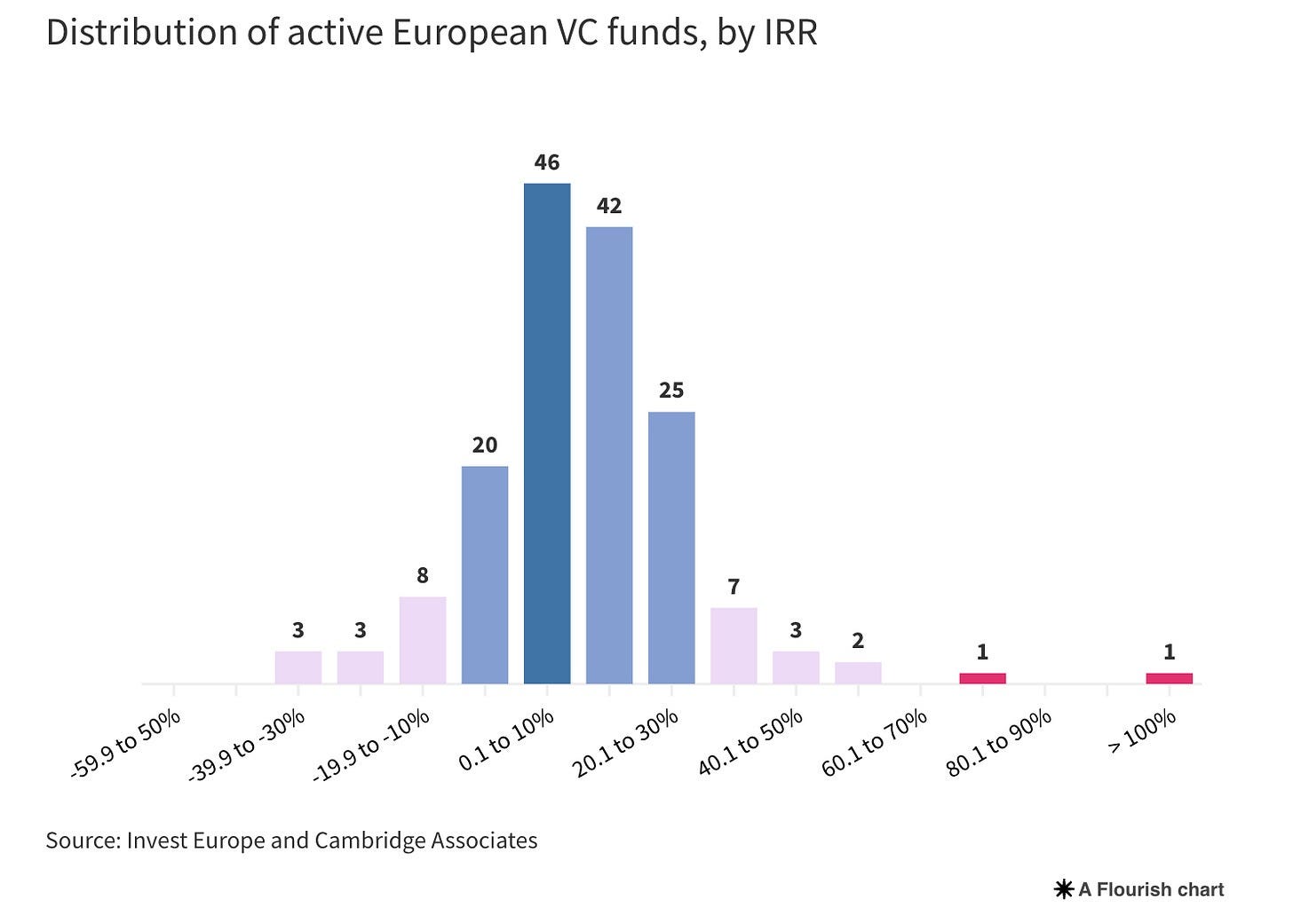
Anecdotally, many LPs are questioning why to lock their money up in such a long duration illiquid asset. The search for secondaries funds, later stage investors and a (misguided) flight to major brand names is all throttling the sector, especially for early stage managers.
Bluntly, these factors combine to make venture look like a tough sell in 2025.
Then you layer on to this the insane overallocation into funds in the 2019-2022 fundraising bubble, with many LPs from sovereign wealth through to pension funds and large family offices already highly leveraged in the asset, and the proposition as a new entrant or pre-DPI yielding fund in late 2025 is not exactly straightforward.
Software start-ups don’t need venture like they used to
This is all before you consider how companies are born, grow and exit is also changing rapidly, leaving less and less space for equity-hungry venture investors.
Founding a start-up has never been easier from pretty much every angle - there are tools for everything from company incorporation to payroll to marketing development to hiring freelancers. AI has not just supercharged company foundations, but also driven considerably higher output per employee, and therefore less headcount needed - a direct proxy for the amount of money a start-up needs to get going.
This, combined with the post-2023 focus on time to revenue/profitability, and drives towards capital efficiency (after the bull market of the 2010s/Covid era) has changed how many early-stage founders think about getting going.
Anecdotally, the concepts of Seed-Strapping (one round to get going, then drive towards profitability fast) and “minimum viable venture” (the smallest possible angel/VC round to minimise dilution early on) have rapidly normalised.

Deep/frontier tech still require relevant upfront investment, and a relevant number of generalist funds are being forced to get more comfortable with investing in physical stuff - but these still feel like edge cases, especially so when you consider most GPs’ discomfort with longer duration deep tech investments and lack of understanding of how atoms function vs. bits.
Excluding more IP-driven applications, I believe this also changes the way companies will mature and exit. There will still be major IPOs and M&A activity, of course, but as many more companies are now built as wrappers on large models, growing rapidly but building moat/defensibility around brand and speed of execution more than any product differentiation, it is unlikely we’ll see so many category-defining multi-billion-dollar companies.

In their place will be a long tail of smaller acquisitions; smaller, profitable, few-employee companies in the <$100m revenue range, or roll-ups of these types of tools by funds / Bending Spoons-style players who bundle together multiple companies into verticalized offerings.
All of which don’t really work that well for venture - either as a way to fund these companies, or in terms of the returns they generate.
Most VCs have never really added that much value anyway (as much as they would like to think they do), some even behave actively badly, and this power shift from supply side to demand side feels like a natural re-balancing of an industry that has wielded far too much power since the mid 2010s.

None of this is to say venture is no longer viable, it just very much feels like the pool of companies available for venture funding is getting smaller. Software just doesn’t need venture like it used to, and while more IP-driven deep-tech applications will pick up some of the slack, the pie is still shrinking as the barrier to entry for bootstrapping almost anything gets ever lower.
Yet the competition is greater than ever
Alongside this, the competition for deals has never been higher. [Come with me while I do some really suspect back-of-the-envelope maths to explain my point]
Firstly, there are 202 unicorns (+$1bn valuation private companies) in Europe (as of late 2024 - this isn’t discussing exits, just “venture scale” valuations that at least look nice on paper). For the purposes of this exercise, I’m going to imagine they were all founded post-2009 (so 14 years of equally distributed unicorn generation).
As of end-2024, there were 4,044 funds involved in at least one deal in Europe (down 30% from 2023)*. The data on funds by stage is murky, but given there are ~60 growth stage funds operating in Europe (30 of whom do +80% of the deals), I’m going to assume we’re splitting funds 70% pre/seed, 25% A-B, 5% growth.
So at the early stages, there are 2831 funds looking for 13 companies per year - 1:217 odds (0.45%). Or, per fund, you have a 1/217 chance of finding one in a given year.
Play the odds 5 times over your fund lifecycle and its a 1:43 chance of finding one -> worse than the power law distribution of 1:25 typically vaunted by early stage funds.
Then on the top end, 2024 European tech exits totalled €61.8bn across 858 deals - or £71m per exit. US exits are hard to calculate as tech isn’t split from broader M&A in the figures, but corporate backed exits hit $48bn across 387 deals ($124m average) within a broader 1,032 mergers and acquisitions of venture-backed companies in the US (no deal value provided).

Or, to put it simply - exits are still really hard to come by, and not that big on average. The ratio of funds and investments to meaningful exits is consistently poor. This makes the job both very difficult on entry and on exit.
*This (very large sounding) number most likely includes family offices, corporate funds, VCTs etc.
So what the hell is going to happen?
Firstly, I think we’re going to see a lot of funds die or quietly disappear, and while it might take a few years to show up in the data (as funds rarely advertise going dormant, plus 10+2 fund cycles give a lot of leeway for a quiet disappearance), you can definitely feel this when you spend any relevant time with GP/LPs.
My bet? 40-50% fewer funds by 2035, but aggregate AUM that’s somewhere similar - concentrated in hyper-scalers and then a long tail of specialist boutiques who are very good at one or a few specific things.

This barbell-ing of venture may well replicate private equity before it - a handful of monster shops, then many small specialists. Just 30 firms raised 75% of all capital in 2024, and 9 of them took 50% of the total, while everyone knows micro-funds are the best performers. Those trapped in the middle ($200m-1bn funds) are the ones to worry about.

I still don’t really understand how the platforms expect to return their monster vehicles - a16z’s targeted $10bn fund would in theory require 10x $10bn exits at 10% ownership (with no dilution), a truly astonishing hit rate, or 2x $50bn, essentially betting on backing the next OpenAI, twice.
Realistically these funds have begun to look more like something between hedge funds and organs of government, not just skimming off hundreds of millions in management fees annually, but influencing policymakers, moving markets and making money in new ways that enrich their teams at the expense of LPs.

But at least the long tail can make this work: a $100m fund can be returned comfortably with ~10% of a $1bn exit or 10% in 2x $500m exits, with anything below being proportionally more straightforward. It’s hard work, no doubt, but it’s manageable even within a low-exit environment.
But not just across fund sizes, I think this market shock will force (/is forcing) more creativity around how investors deploy capital and how LPs back managers.
I’ve long joked venture is finance for people who don’t understand how money works, and it really has felt like this for a while - with certain exceptions there has been minimal innovation on the 2% management fee, 20% carry model in the 25 years venture has been active in Europe. Perhaps little wonder when you consider the classic path of founder/operator → GP, no bankers in sight.
We’re seeing this shift in the plethora of secondaries funds that have popped up, essentially as a short term drive for liquidity, but also in novel blended financing models, “sight unseen” / “option cheque” vehicles within bigger funds, the PISCES plan to bring liquidity to private company shares, VCs taking stakes in roll-ups, VCs experimenting with public equities, VCs trying to incubate, VCs buying crypto, funds of funds within funds etc.
As mentioned, LPs are also responding - pushing for access to later stage funds, buying GP-led commitments for more mature vintages at a markdown, and running towards secondaries funds or reliable brand named platforms - that realistically no one will be fired for backing.

Overdue innovation in the sector
This overdue business model and fund size innovation speaks to a series of scenarios for venture in the latter half of the 2020s. Here are a few predictions:
I foresee funds barbell-ing towards either data-driven and programmatic - index the market, or at least the top decile. E.g. Tiny, Onstage, YCombinator, Unruly or high conviction, low velocity deployment strategies a la Thrive, Benchmark, Kindred (where I’m very lucky to work). Again, mid ownership, mid fund size, mid deployment cadence seems to lose out here.
We’re already seeing it, but more funds will look to do option tickets alongside their main strategy. a16z does it, Sequoia/Accel have scout programmes, EF does it, and countless others do it on the sly. This will become the norm for anyone deploying from +$100m vehicles as buying optionality and increasing network are ever more important.
The competition for early-stage deals will continue, pushing investors to be even more creative in how they market themselves to top founders who are now more choosy and less desperate. This is funds backing hacker houses, running conferences, having grant-making vehicles/fellowships, hosting more hackathons / legitimately valuable events, and meeting founders where they are - in universities, while still as operators in scale-ups etc.
I venture we’ll see more bankers in the sector doing more banker-like things. Novel innovations on blended fund models across stages, merchant banking for efficient early stage company fundraising, multi-manager GP structures, investing into things that didn’t traditionally feel venture (drug development, NVIDIA stock, video game studios, crypto, secondaries etc.) and selling portions of the GP sooner to generate liquidity or double down on SPVs for top performers.
The best returns will continue to come from super specialists - either geo experts, sector experts or “archetype” investors e.g. operator focused, second time founder focused, technology or character trait focused. Taste will be paramount as the key driver for the long tail of smaller funds, and sub-sectors (deep-tech, climate) will further specialise (chips, energy) with value compounding in those comfortable with getting creative around new sectors, business models, technologies or markets.

We’ll also see more blended models where funds look more like hedge funds or PE shops - bigger ownership stakes, lower multiple (lower risk) investments alongside moon-shot bets etc. We’re seeing it with the platforms, but expect this to move downstream as others work out how it works and look for quicker routes to liquidity.
And we’ll likely also see a fair few older funds just ride the management fees until the lights finally turn off. There’s just too much cash flowing around legacy brands with mediocre returns for this party to end just yet.
All said, I’m ok with this
Fundamentally, I think this is all a good thing.
It’s not going to be hugely comfortable, and a lot of people won’t enjoy it, but it should gradually re-set the industry to something lower status and higher value - closer to how it was in the early 2010s.
The platform funds have become something that isn’t really venture capital anymore, and so are hard to assess through this lens. While their size, political might and market setting capacities raise eyebrows, they also provide both the capital and patience to help risky, profoundly impactful technologies mature before hitting the prying eyes of public markets.
The boutiques are where the value will accrue - specialists, hustlers, risk takers and zealots who will take crazy bets on IP-led companies at the earliest stages, then ride the growth with them and return outsized multiples to their backers. This feels like a return to venture in a purer form - taste driven, risk-on capital that’s founder-focused and in it for the societal impact as well as the exits.
For sure, we will see a lot of talent move out of investing and (ideally) into start-ups (but probably back to McKinsey), a lot of funds disappear (really, not a bad thing - there are way too many), and a lot of zombie start-ups as a by-product of their previous investors ceasing to exist (a shame, but ultimately something that will concentrate talent into the winners).
Sequoia might be 53 years old, but most of venture capital is a nascent industry, 25 years old at best (especially in Europe). It’s been a child and a troublesome teenager since the turn of the century, now’s time to grow up - into something more solid, more lasting, and hopefully more beneficial for all involved.
I’m Max - I write sporadically about things that interest me, often centred around technology and how it affects our lives. Loved it, hated it? Neither? Tell me.
The function of VCs right now is to allow small companies to compete for talent with the $T monsters. This enables activity but at a cost of overvaluation. Hard conundrum to solve.
Love this. Amazing in fact. Your brain and ability to explain things never ceases to amaze me. Hope you’re well. Keep it coming.