

If you haven’t heard of prediction markets yet, I can guarantee you will have done by the end of this year.
A prediction market is a specialised financial exchange where individuals trade contracts based on the outcome of future events - or, in human speak, a website that lets you bet against other people on whether something will happen or not, or the way in which a thing is going to occur.
As of 2026 there are two major prediction markets running online - Polymarket and Kalshi - both founded in 2021. The former has lower total historical trade volumes ($17.6bn vs. Kalshi’s ~$28bn), but is growing considerably faster (~$100m daily vs ~$17m). Both have raised considerable sums of money. To put these volumes into perspective, the UK gambling industry had gross revenues of £16bn ($21.4bn) 2023-24, or £43m ($57.6m) gambled per day.
These markets allow you to bet on all sorts of mad stuff - how much the next Avatar film will gross, whether the US will invade Iran, who wins the Superbowl, or who’ll be outed in the next set of Epstein files. If you can imagine it, and measure the outcome, there’s a potential market out there. (To understand how they actually work, read this)

Now, the technologist in me absolutely loves this. It’s P2P (running on crypto rails), decentralised (no “bookie” is setting the odds), real time and absolutely bonkers. Back in 2024 there was literally a Polymarket trade on the duration of lizard man Bryan Johnson’s nighttime erections. This is the internet at its freewheeling, chaotic best.

But there’s also a terrifying, dark underbelly to all of this. Over the last few weeks I haven’t been able to stop weighing up the negatives - insider trading, the effect on politics, gambling framed as investing, reality as a derivative of the market - versus the positives - the democratising nature of real time “true” polling, skin-in-the-game staking of real world events, and gambling without the stacked odds of betting organisations.
Here’s my attempt to make sense of it all.
It’s all just sports betting from here
The traditional worries around sports betting have always been that it would debase the value and enjoyment of sports - turning something pure (“Go! Team!”) into something complex and muddy (“Well, I might be able to hedge a loss by making some money on the other side”). In the UK we’ve had legal sports betting more or less since the Tudors, and none of this has happened - yes, sports gambling is dangerous and addictive - but it also hasn’t ruined the viewing experience for the vast majority of fans, nor the sports themselves.
I worry politics might be different. Firstly, betting on sports doesn’t change the outcome. The event is discrete, undertaken by professionals, has well established and clearly defined rules and boundaries on cheating or match fixing, and, thank the lord, is generally loved intrinsically by those that perform it meaning the vast majority of participants can be considered “good actors”.
Politics doesn’t always look like this. It’s dirty, partisan, drawn out, chaotic, open to malicious influence, and the opinion of an event or decision can fundamentally alter its outcome. Just look at the example of the “French Whale” in 2024 - a series of bets by one Frenchman totalling $80M on Trump on Polymarket. Regardless of the intent, the sheer size of the bets influenced the odds, and in turn the media narrative of “Trump momentum” when the polls were deadlocked. It’s hard to say whether this skewed the result, but the precedent is there.

Admittedly this can happen in many different fields - Elon Musk’s use of X as a mouthpiece for Trump’s campaign was no less influential, nor Biden’s stumbling in the debate. However the difference here is that from the outside, a prediction market “probability” looks like the aggregate of many thousands of opinions, and speaks to us in the language of polling. It feels legitimate, balanced even.
Now in a perfect market, even a “whale” sized bet clears to zero as the market sees the inefficiency and re-balances the odds. However politics is so fast changing, these moments can be of great influence. A 24h skew on prediction market weightings the day before an election could be enough to influence public opinion, especially as the volumes reach significant levels and the prediction market odds are cited in mainstream media.
And for those who say “we’ve always had betting on politics!”, the difference here (as is almost often the case with the internet) is the speed, scale and visibility. No single betting shop has the potential international profile of these markets, nor the real time or peer to peer nature. Gambling apps don’t look like or feel social media sites, and come stock full of boring (important) warnings and alerts. Moreover, the sense you’re betting against John Doe (or 1000x John Doe), not the house, makes the whole thing seem less weighty and less risky, but arguably more representative of public opinion.
Memeified decision making
But at a deeper level than this, I worry about this for what it does to decision making in society. Young people are already woefully disengaged with politics across developed nations. The lurch to extreme political views is in part due to exhaustion with the stale nature of politics, but I believe also because engagement and understanding are at record lows.
And this trend could serve to compound this. Peer to peer betting creates yet another abstraction layer between the individual and the reality - gamifying and memeifying socially and economically profound decisions.
“Vote for X? Well the odds look good so YOLO”. It turns everything into a “moment”, distancing the decision from the reality, distorting the incentives, and ignoring the second order consequences. It reminds me of a friend who voted Brexit as a joke because they thought it would never happen. Imagine if he had also had upside and potential clout. This kind of poor decision making is very hard to undo when the timeframes and reality of politics and society don’t match up with the speed, relative ease and excitement of an online flutter.
It’s perhaps an extreme framing, but what happens to the already fraying social contract when we stop being citizens and shift to being odds-maxxing voyeurs? If I no longer feel incentivised in the future of my nation, and have frictionless ways to hedge against it, why wouldn’t I? It feels that lurking deep below the memeification of society is a dark undercurrent - one of status over substance, and get-rich-quick grift over hard earned marginal gains.
Bad people doing bad things, from anywhere
This is before you consider the fact this is a digital exchange that knows no borders. You can’t (currently) bet on these markets with a UK IP address, but this is easily solved using a VPN, especially so given the currency of choice is crypto.
While the Trump Administration (in its infinite wisdom) has gone all in on these markets, legalising them after a period in the regulatory wilderness (and regulating them not as gambling but as financial markets), I believe domestic activity is actually a different concern to international influence.
The French Whale example is important because it was a non-US actor influencing the odds on a US event. Russian/North Korean troll farms must be licking their lips at the opportunity for fully anonymised chaos mongering. This is social media influence but in one big town square, with odds that are now officially broadcast on mainstream news outlets as events unfold, giving them ever more legitimacy and relevance.
Incredibly efficient insider trading
One of the most startling recent reveals about the never-ending Trump family kleptocracy is that Donald Trump Jr is currently an advisor to BOTH Kalshi and Polymarket.

I don’t want to sound too much like a CNBC/EU Commission pearl clutcher, but this absolutely stinks. The opportunity to rapidly and lucratively capitalise on insider information in a sector not currently regulated as gambling is simply too obvious to ignore. This will be old news by the time I publish this piece, but on January 14th this happened:

The same happened with Maduro’s ousting a week earlier. Someone joked to me the other day to get any insider bets I can in on one of these platforms before (proper) regulation comes in - and while this regulation is inevitable, my concern is that given the ease of operating across borders and anonymously, regulation will have a very hard time catching up. This will be especially challenging when the government responsible for regulating the platform in the US (and so most of the world via VPN) appears to be as crooked as they come.
Reality as a derivative of the market
To take this one final level weirder - what happens if the markets then end up influencing the nature or timing of the events?
In a life-imitating-art moment back in November 2025, Coinbase CEO Brian Armstrong spewed a string of crypto jargon at the end of a Q3 earnings call that happened to exactly match a series of polymarket bets, resolving $84K of wagers in the process:


While he claimed afterwards this was a joke, did he say “Web3” because he found it funny, or because he bet on it? Could the raid on Maduro have happened when it did not because it was strategically necessary, but because a whale needed the contract to settle before Jan 31? In a world where we seriously consider flooding the zone as a genuine tactic to avoid Epstein file releases, stranger things have indeed happened.
Journalist Kara Swisher predicted recently that 2026 would see the first major prediction market driven negative incident (e.g. a murder that was not going to happen anyway occurring due to big upside on a prediction market). This is dramatic (and I believe quite unlikely), but, what about an older sports-person fluffing a few timely shots to make a quick buck before they retire, or a politician dropping out of a race at a very specific moment then riding off into the (as yet unregulated) sunset, cash in hand?
Prediction markets threaten to turn reality into a derivative of the market. My head is now hurting. (If you want it to hurt even more, read this brilliant deepdive).
Real time polling, real time engagement
Now, enough with the hand wringing. These platforms scares the hell out of me, but there are also some very valid potential upsides. Ethereum’s Vitalik Buterin made some neat points:
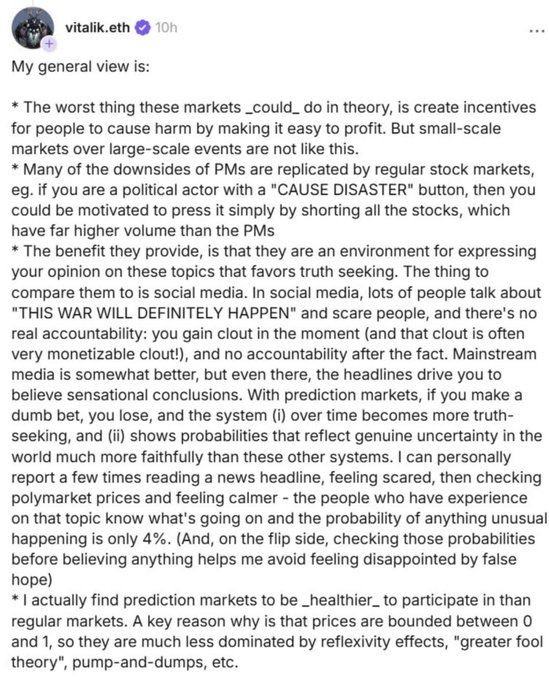
I particularly like the idea that these markets provide a “skin in the game” way to publicly take stakes. Much like buying equities or voting, the positive spin is that this is a leveraged way for individuals to have a voice, and that the average of the (incentivised) commons could well end up more accurate than legacy polling methods.
The wonderful Benjamin Graham quote that "In the short run, the market is a voting machine, but in the long run, it is a weighing machine" applies here - but in some ways collapsing the two into one measure. Prediction markets can become both a way to vote on the news and a source of news themselves.
There is something amazing about the ability to have a real time barometer of thousands of individuals’ aggregated opinions on world events. In a internet-as-democratising-tool way, the participant to voyeur could also be viewed as participant to pundit, but where the pundit has a real (financial) reason to take a stance.
Perhaps in fact this staking has the opposite effect of distancing individuals from reality? The techno-utopian take would be that this democratisation drives civic engagement, creates an immediate incentive for individuals to read up on topics, and broadens the market for news consumption. It remains to be seen.

Short odds on bad stuff
It’s important to note that prediction markets are not new - there’s five hundred year old evidence of betting on Papal Elections for example - and society doesn’t seem to have collapsed in the interim. Perhaps this time it isn’t different, and my concern is as unfounded as the millennium bug or crypto-induced collapse of the financial system.
However, what puts me in a “this time it’s different” mindset here is the aforementioned speed, scale, publicity and lack of rules. This moves so fast, has so few guardrails, is run by what seem to be a pretty dubious bunch, looks harmless yet contains so many avenues for malicious activity, is SO public, doesn’t look or feel like gambling, and crosses borders without the slightest friction.
I have always felt that the internet is this vast, blind amoral beast. It just doesn’t care about good or bad, whether you win or lose, are happy or sad. At once it contains contains both the most wonderful things on Earth and the most terrifying things imaginable.
Which is exactly why it needs consistently thoughtful, endlessly iterative, exhausting forward thinking regulation. This may well be a short term pain that ends up looking more like traditional gambling or public equities, but my worry is the damage done in the interim could be very hard to undo.
I’m Max - I write sporadically about things that interest me, often centred around technology and how it affects our lives, while investing in start-ups via Kindred Capital and Anti Ordinary. Loved it, hated it? Neither? Tell me, or just binge my content @ maxbray.xyz
+ Thank you to the Nerdy White Guy Copy Editing Club © (Titas, Will, Rob, Alex and George) for thoughtful feedback / input here.
The whale image is particularly good
Love this! I shared a pretty lengthy deep dive on Kalshi here last month (focused mostly on the bull case) if you’re interested!
https://open.substack.com/pub/theuncredentialed/p/kalshi-building-a-truth-machine?r=26ya72&utm_medium=ios&shareImageVariant=overlay