

I’ve been trying to formalise my thinking through a series of thesis documents, starting with frameworks on world models for investing and spotting unique entrepreneurs in the wild.
To follow-up on the former, I’ve been itching to dig into a number of ideas on where I think the world could be in a decade, considering specifically how this might impact technology - as in venture capital we’re realistically more crystal ball gazers than real time market analysts.

The first of these is the fundamental demographic shift the world is undergoing, including imminent population decline (and accompanying labour shortages) in developed countries, continued population growth in the Global South, and climate induced mass migration.
I believe these will impact physical labour automation, our societal focus on fertility and longevity, how we think about border security in nations fortunate enough to be desirable destinations, and the need for global cooling efforts.
Read on for my thinking around how this could play out.
—
Fewer people to go around
After hundreds of years of sustained population growth (and a veritable explosion in the second half of the twentieth century), we’ve crossed the tipping point towards population decline in much of the world.
Many nations in the Global North are looking at imminent decline, and those in the Global South are seeing the rapid growth numbers of the last half century slowing with predicted drop off coming by the latter half of this century.
Much has been written on this topic recently - the Economist had an excellent reader on this a few months back, Ezra Klein discussed it last year, the brilliant Unruly team covered it (in perhaps slightly more dramatic framing than I would be comfortable with) a few weeks back, and David Runciman took >7000 words in the LRB to go into this subject in great detail earlier this year.
Tl:DR? On most models, we’re pretty screwed. Once birth rates drop below 2.1 babies per couple, population declines. (Because a couple is 2 people, so without replacing them +0.1, population inevitably declines)
Many expectations suggest the global population will peak around 2080, although ONS expects the UK to level out (without continued large scale immigration) as early as 2029 - many European nations look similar. Given this prediction came out before we saw a +60% drop in net migration YoY into the UK, this number could come even sooner in a low immigration environment.
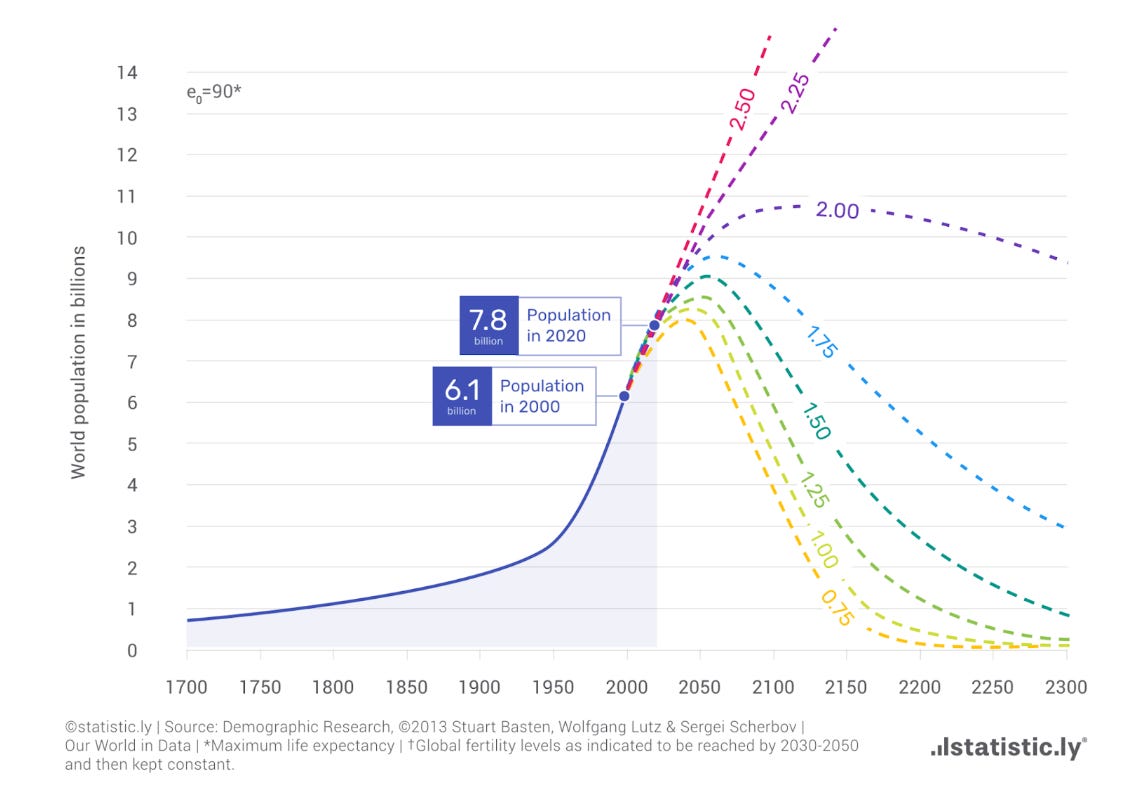
Once you cross that key 2.1 replacement threshold, you start running out of young people to look after old people. You start running out of productive workers. And without major productivity increases, the productive capacity in the economy falls and tax receipts drop.
As we’re all living longer, this tends towards top heavy populations with the dependency ratio (of expensive old people to tax-paying young) worsening over time. Between 2000 and 2100 the proportion of the world aged 65+ will triple. The scariest part about this is that the lag is huge - not only does it take a long time to show, but it takes literal decades of population re-growth to re-set.

The reasons for this decline are multiple - educational standards increasing, especially for women, shift priorities from homemaker to active participant in the economy. Cost of living increases have pulled children per parent down across the West - as the Wired team noted in their recent podcast on the topic, the ultimate San Francisco status symbol is “three kids and a Rivian”. And declines in religious superstition and instruction have removed the divine imperative to go forth and multiply.
Hold on - what about the Global South!?
Yet within the next half century, we’ll also still see populations continue to grow in many developing economies (in part due to the lag in decline once a nation falls below the 2.1 rate), and a strong correlation between these young, fast growing populations and susceptibility to climate change.
As of 2025, India is growing at ~24 million people a year. A country of 1.35bn people adds the population of Mali (or 35% of the UK), annually. And even though the replacement rate actually dropped below 2.0 in 2020, it will still take until the 2060s for population to peak (somewhere around 1.7 billion).
Indonesia keeps growing +1% annually, expected to hit ~320m by 2060 (from 284m today), while the population of wider Sub-Saharan Africa is growing at an annual rate of around 2.3-2.7%, expected to reach approximately 2 billion by 2050.
Now in many ways this signals a natural correction to the decline of the tired, developed world. Empires rise and fall, and this is certainly shaping up to be the century of the Global South. You only have to fly through an airport in the Middle East to feel this shift. However, the correlation between developing nations and vulnerability to major climate shocks and broader temperature rise throws an uncomfortable spanner in the works.
In a highly cited prediction, the World Bank’s worst-case estimate for climate induced migration is that some 216 million people could move internally by 2050 (~2.6% of the predicted global population in 2050), +80 million of which will be in Sub Saharan Africa.
As noted by the Migration Policy Institute, climate-driven migration generally begins within nations, with climate-related disasters pushing populations internally. This has already happened within countries such as Somalia and Guatemala in recent years.
As these disasters develop into broader ecosystem collapse, with rising temperatures, rising sea-levels, and droughts, such migration will inevitably bleed across borders, and will push populations of (generally less well off) nations towards refuge in their more temperate (and wealthier) neighbours. 2015 saw the first asylum claim by a Kiribati islander to the New Zealand government based on sea level rise. It was rejected, but it felt like a sign of things to come.

The numbers around international migration are difficult to predict, lacking both precedent and underlying thesis, but the 2015 migrant crisis Europe saw based on the Syrian and Afghan conflicts suggest a pattern for a problem we’re set to grapple with for the next century. When conflicts break out over diminishing resources both between and within nations, this problem is likely to compound - supercharging the population movement in ways we cannot yet predict.
Once regions such as Sub-Saharan Africa and the Indian subcontinent hit unliveable temperatures for extended periods each year, or crop failure becomes genuinely widespread, greater numbers of people will be forced to become ever more nomadic. If even a small percentage of these move west and north, the impact on Europe could be seismic.

Shifting labour markets
And herein lies the strange cocktail. As populations age and shrink in Europe, they will continue to rise elsewhere, while being forced to move in ever greater numbers. On paper, a logical exchange as younger, poorer populations seek refuge and opportunity, and older economies seek productive capacity to prop up ageing populations.
Yet the rise of nativism and anti immigration sentiment complicate this trend. Even if the data shows European populations have only slightly cooled on their 2010s bullishness towards migration, the popular narrative has shifted, and pro-immigration is a challenging stance for any European or US party to take into 2026.
There is now a disconnect in the political landscape between the need for workers and perspectives on migrants. And in some ways there is logic within this - the UK has 9 million economically inactive adults, easily enough to offset a very large percentage of new arrivals if coaxed back into work effectively (but I have no desire to delve into these politics here).
Regardless, we still need pretty much every type of worker, but especially those who serve ageing populations - carers, logistics, hospitality workers, etc., alongside skilled positions including engineers, technicians, teachers etc.

Welcome to your automated future
As humans struggle to fill the labour shortages, and robotics continues to advance apace, the opportunity for automation within this landscape is going to be considerable. As Roman Hölzl of RobCo (a Kindred portfolio company) cited recently, there could be as many as 4 million unfilled manufacturing jobs in the US and EU by 2030. And this is before you add in many of the sectors facing shortages cited above.

Some of these gaps will inevitably be filled by renewed focus on local retraining and migrant workers, but we’re also going to observe a massive shift towards robotics-led automation. Not only are robotics rapidly approaching cost parity with human workers in many sectors, but we’re already seeing impressive deployed applications across factories, warehousing, transport, logistics, farms, shops, kitchens, precision manufacturing and much more.
We will undoubtedly also see artificial intelligence throwing another spanner into the works here - the warnings of great job displacement are sounding increasingly prescient as major services companies begin to announce large-scale job cuts. On a positive timeline, AI/ML-driven systems automate dull jobs where humans serve as APIs (connecting bits of data/processes). On a darker timeline, we see large scale unemployment due to AI/robotics efficiency with no clear path to productive job replacement.
My uncontroversial ground take is that we’ll see a reorganisation from repetitive white collar jobs back towards hard to automate services industries. As the growing dependency ratio highlights, caring for the elderly is an ever-increasing concern - yet the care sector feels a decade or two out in terms of robot development.
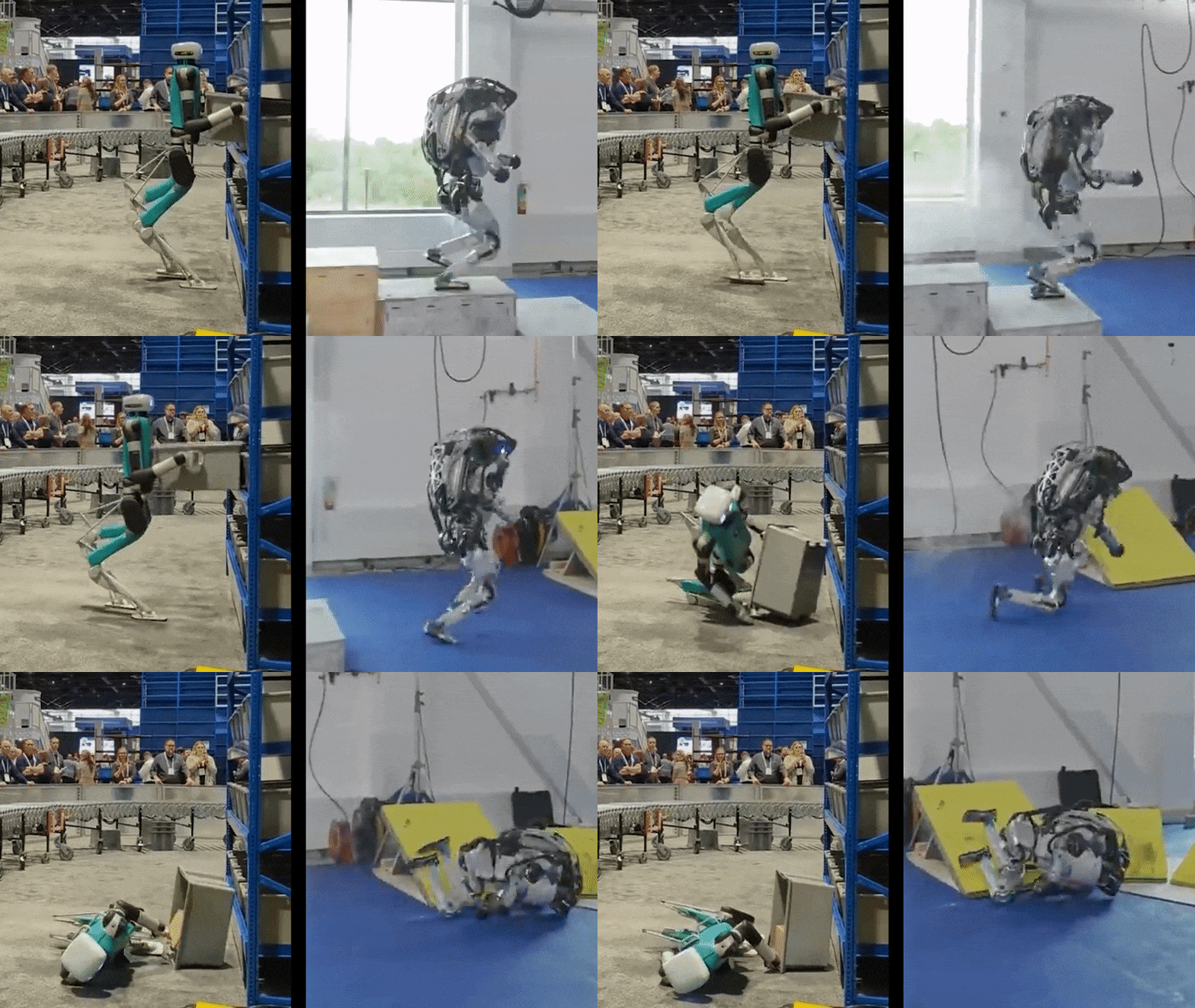
Humanoids are still pretty clunky, and older populations will likely remain distrustful of autonomous assistance for some time. Moreover, the dexterity, complexity and soft touch requirements of working with vulnerable or elderly people are a far cry from pick and pack in an Amazon warehouse. Dexterity will be a major focus for robotics companies in the next decade as the “hands problem” remains unsolved.
Similarly, trades such as physiotherapists, plumbers, electricians or lab technicians will far outlast most email jobs- and with this we’ll likely see a rebalancing of the relative social status of skilled physical labour versus its desk-based equivalents.
We need to make more babies
At a more basic level, expect considerable effort applied to getting more humans to make more humans.
Government efforts to boost populations (such as cash for having kids, tax breaks for working parents, free childcare etc.) have generally fallen flat. Yet it feels inevitable technology will be employed on top of these to both ensure high levels of efficiency in fertility, reduction in negative outcomes, and innovation in early years care.
The concept of artificial wombs is a fascinating one, essentially grow-in-a-bag babies, which could eventually help overcome challenges faced by older couples or those with personal reproductive issues. While decades out at the minimum, the ethical challenges are obvious - whether we move towards a world that changes its attitudes to family structures and how we procreate, with science fiction having done an excellent job at imagining corporate owned reproduction, children without parents, or cloning for all sorts of nefarious ends.

On a shorter (and less terrifying) horizon, expect also to see even greater focus on IVF, egg freezing and conception aids to open up more chances to conceive to older or work-focused couples. Early years childcare could also see innovation - offsetting the insane costs paid by parents in urban areas for nurseries by optimising the childcare model with new technologies.
IVF costs continue to fall, and both egg freezing and IVF have normalised as work benefits, signalling their popularisation, with novel products emerging to reduce the financial burden on prospective parents or employers. Kindred backed Gaia a few years back, offering fixed price IVF + insurance to offset the high medical bills offered when going direct to clinic.
Longevity as a social imperative
As populations age (and shrink), maximising productive capacity across the life of an employee will be ever more important, and if cost of living continues to plague populations, quality adjusted life-years (QALYS) and skill retention/retraining will be extra important as retirement will look less viable for many workers.
Cognitive decline is already being tackled with focuses on neurodegenerative conditions, supplements for brain function, and preventative medicine, while physical decline, muscle density and mobility are major focus areas for the longevity movement in the past decade.
Punting out a bit further, (largely stealth) start-ups and Big Pharma are riding the GLP-1 wave, trying to apply the technology to alternative areas - addiction, mental health challenges, and even reducing the hours of sleep needed by humans - all of which could benefit productive capacity by enabling longer, more productive careers, or more output per worker during their best years.
Defence tech for border security
An uncomfortable reality is that alongside focusing on growing domestic populations, this climate induced mass migration will likely continue the decadal trend we’ve seen in anti-immigration sentiment across the West.
If the numbers continue to rise, defence technology applications may well be repurposed for border defence use cases - with drone technology, autonomous boats, positioning systems, heat sensors etc. employed in civilian environments.
Internally, this may well look like a greater use of surveillance and identity tracking for domestic populations. There is already controversy in the UK around expanded police use of facial recognition alongside age estimation for recently arrived migrants - but in a world where identity cards are employed more widely and civilian attitudes harden towards illegal immigration, the end state feels somewhat inevitable. While hard to stomach, ICE (and their relationship with Palantir) feels like a bellwether more than an outlier.

A perhaps less dystopian angle here is technology employed to enable and support short term itinerant work, such as automating short term visas (already used at scale in US agriculture), and tracking their use vs. traditional, outdated paper systems.
Global cooling, at scale
Given the speed and intensity of global temperature increases in the last decade, there is a not-insignificant chance we end up deploying some form of large-scale global cooling - and this could well be driven by the short term pressures of population movement from countries that can’t afford this themselves into countries that can.
The theme of geo-engineering is one that has broken through in recent months, such as solar radiation modification (or solar geo-engineering), an umbrella term including stratospheric aerosol injection (SAI), marine cloud brightening (MCB), cloud thinning, space sunshades etc - all of which can provide short term temperature reduction in a rapidly heating world.

How these technologies pan out commercially, and indeed how the public views them is as yet unclear (we invested in Stardust this year). This could look like a multi-national coalition of the willing (e.g. UN/NATO led efforts), rogue nations deploying their own efforts, or insurance/private enterprise deploying to protect global assets/portfolios. However it happens, this sector will both increase in public relevance and attract more funding - both public (e.g. ARIA’s £56.8m explorative programme) and private (e.g. Lowercarbon leading a $60m round into Stardust) - in the next decade
Where do we go from here?
These trends are broad, long duration and complex. I personally have a quiet suspicion that population decline is not inevitable as I find the “end of humanity” argument to be a little overdone. To me it smells more like a Millenium-bug panic than something that ends our species, especially as we humans have a startling ability to surprise ourselves and not foresee the unknown unknowns.
There are many things that could offset this decline. Genuinely reducing the cost of living while creating a vision of the future founded in optimism (not fear) is a scenario I still have some hope in. There’s also the relevant chance AI fundamentally alters how we understand growth and output, changing the fabric of how governments raise tax revenues and deploy welfare support, unlocking both resource and time for parents.
Alternatively, I do fear the spectre of an intellectual slowdown that welcomes in a new cultural dark age, where artificially super-intelligent computers take the cognitive slack and man shifts into an HG Wells’ Time Machine style adult infancy of leisure-based decline, procreating at higher rates as education levels and expectations fall.
For the first time in centuries we’re getting dumber and more superstitious - our critical faculties are declining, our faith in institutions is falling, and religious fervour is once again on the rise - all of which could usher in a new era of social norms.

What is clear however is that the challenges around short term labour shortages and people movement feel as pressing as they are politically explosive.
Without unforeseen innovation in reversing climate change, population decline or at-scale automation, we are approaching a period where the needs of old economies could best be served by their younger counterparts, but the appetite does not feel there as of late 2025.
How this plays out, and where new technologies can be of use will be key questions as we continue into the latter half of the 2020s and beyond.
I’m Max - I write sporadically about things that interest me, often centred around technology and how it affects our lives, while investing via Kindred Capital and Anti Ordinary.
Loved it, hated it? Neither? Tell me or hate binge my content @ maxbray.xyz
Really strong analysis of the demographic collision we're heading into. The disconnect between European labor shortages and hardening immigratin sentiment is particularly striking, since the fix for one amplifies the other in such volatile ways. One angle that stands out is solar geoengineering potentially being driven not by global consensus but by wealthy nations protecting themselves from migration pressure, which could create pretty wild geopolitical dynamics when temperate climates become artifically maintained zones.
So we’re not going to see a jobs apocalypse. And countries that can integrate global talent into their economies (not necessarily through immigration - through investment for example) will be winners.